
Advanced Python Data Analysis Methods for Large Data Processing
Advanced Python Data Analysis Methods for Large Data Processing
Modern businesses generate massive amounts of information every day. From customer records and sales reports to website traffic and machine learning datasets, managing large-scale information has become a major challenge. This is where advanced data processing techniques become important.
Using Python Data Analysis, organizations can process huge datasets faster, identify patterns efficiently, and make better business decisions. Python offers powerful libraries, automation tools, and scalable solutions that help analysts and developers handle complex data operations with ease.

Why Large Data Processing Matters
Large data processing helps companies work with millions of records without slowing down performance. Businesses use advanced analytical methods to:
- Detect trends and patterns
- Improve customer experiences
- Build predictive models
- Automate reporting systems
- Support real-time decision-making
As industries continue to rely on data-driven strategies, advanced processing methods are becoming essential for accurate and efficient analytics.
Key Advanced Python Data Analysis Methods
Data Cleaning and Preprocessing
Large datasets usually contain incomplete information, duplicate entries, incorrect formatting, and inconsistent values. If this raw data is used directly, it can affect the accuracy of the entire analysis process. That is why data cleaning becomes one of the most important steps in advanced analytics.
Python provides powerful libraries that simplify preprocessing tasks and reduce manual effort. Tools like Pandas and NumPy help analysts handle missing values, remove duplicate records, standardize formats, and organize data efficiently. Many professionals also integrate Open Refine with Python workflows to improve large scale data preparation.
A properly cleaned dataset improves reporting quality, helps machine learning models perform better, and minimizes errors during decision making. In large data environments, automated preprocessing techniques also save significant time and improve workflow efficiency.
Working with Distributed Data Systems
Traditional processing systems often struggle when dealing with massive datasets that contain millions of records. As businesses generate more information every day, distributed computing has become essential for handling large scale analytics tasks efficiently.
Distributed systems divide data across multiple machines so processing can happen simultaneously. This reduces execution time and improves performance when working with complex calculations or real time analytics.
Some widely used technologies include:
- Apache Spark
- Dask
- Hadoop integrations
These frameworks help organizations process terabytes of information without overloading a single system. Python integrates smoothly with these technologies, making it easier for analysts and engineers to manage scalable data processing environments.
Distributed processing is especially useful in industries such as finance, healthcare, e-commerce, and digital marketing, where data volumes continue to grow rapidly.
Data Visualization for Large Datasets
Analyzing large amounts of information becomes much easier when data is presented visually. Charts, graphs, and dashboards help businesses understand patterns, trends, and performance metrics quickly.
Python offers several advanced visualization libraries that support both static and interactive reporting. Commonly used tools include:
- Matplotlib
- Seaborn
- Plotly
- Bokeh
These libraries allow analysts to create detailed dashboards, heatmaps, trend reports, and real-time visual analytics. Interactive visualizations are especially valuable because they help management teams explore data without needing technical expertise.
Good visualization techniques also improve communication between technical teams and business stakeholders. Instead of reviewing complex spreadsheets, decision-makers can quickly identify important insights through clear and organized visual reports.
Machine Learning Integration
Modern data analysis is no longer limited to simple reporting. Many organizations now combine analytics with machine learning to predict future outcomes and automate decision making processes.
Python supports advanced AI and machine learning development through highly popular libraries such as:
- Scikit-learn
- TensorFlow
- PyTorch
These tools help businesses build predictive systems for customer behavior analysis, sales forecasting, fraud detection, recommendation systems, and operational optimization.
Machine learning integration also improves the value of large datasets because companies can discover hidden patterns and trends that may not be visible through traditional analysis methods. As artificial intelligence adoption continues to grow, Python remains one of the most preferred technologies for scalable analytical solutions.
Database Optimization Techniques
Managing large datasets efficiently requires strong database performance. Even powerful analytics systems can become slow if databases are not optimized properly.
Analysts often improve database speed using techniques like:
- SQL query optimization
- Database indexing
- Performance tuning
- Cloud database integration
These optimization methods help reduce processing delays and improve data retrieval speed. Faster database performance allows organizations to generate reports more quickly and support real-time analytics systems.
When combined with advanced Python Data Analysis workflows, optimized databases create more reliable and scalable data environments for businesses handling large amounts of information daily.
Automation in Large Data Processing
Automation has become an essential part of modern analytics because manual processing consumes time and increases the chances of human error. Python allows organizations to automate repetitive tasks and improve overall productivity.
Common automated processes include:
- Data collection
- Report generation
- Data transformation
- Scheduled analytics workflows
Automated scripts can run continuously without requiring constant human supervision. This improves consistency across reports and helps businesses maintain accurate analytical systems.
Automation is particularly useful for organizations that generate daily or hourly reports. Instead of manually updating spreadsheets and dashboards, companies can use Python-based workflows to process information automatically and deliver real-time insights faster.
Cloud Based Data Processing
Cloud technology has transformed the way businesses handle large-scale analytics projects. Instead of relying only on physical infrastructure, organizations now use cloud platforms to store, manage, and process massive datasets more efficiently.
Popular cloud platforms include:
- AWS
- Google Cloud
- Microsoft Azure
These services provide scalable storage, high processing power, and flexible computing resources that can grow according to business requirements. Cloud based systems also reduce infrastructure costs and simplify collaboration between teams working from different locations.
Python integrates well with cloud platforms, allowing analysts to build advanced analytics pipelines, automate workflows, and process large datasets remotely. Cloud computing also improves accessibility, security, and backup management for modern data-driven organizations.
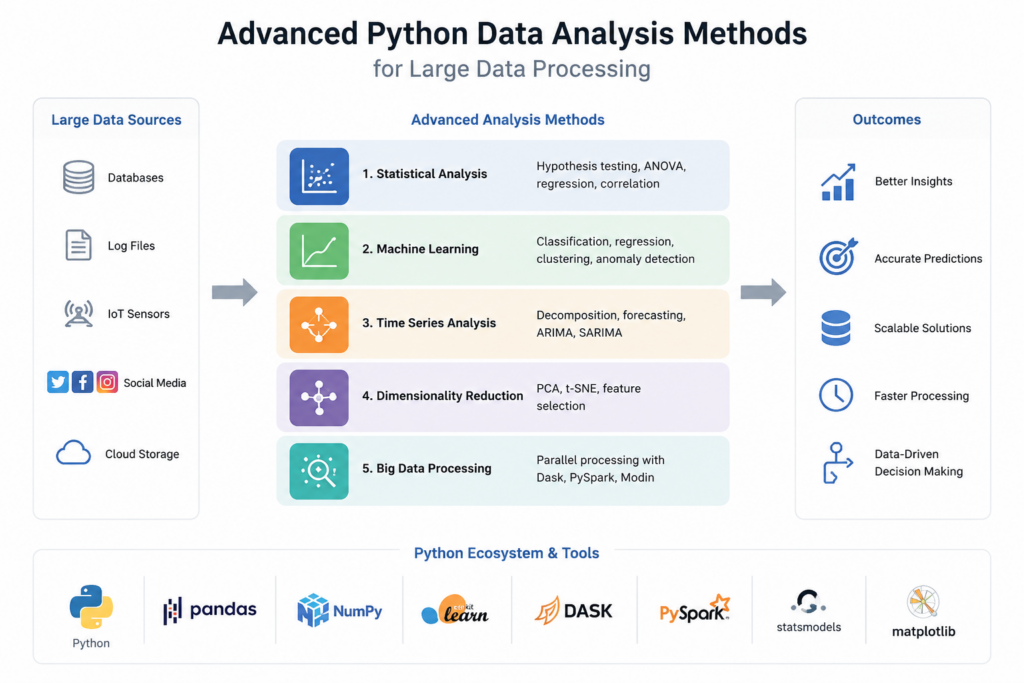
- Advanced data processing methods help businesses manage massive datasets faster and more accurately using automation, distributed computing, and machine learning tools.
- Python libraries like Pandas, Dask, and Apache Spark improve scalability, reduce processing time, and simplify complex analytics workflows for large-scale data systems.

Benefits of Advanced Data Processing Methods
Businesses using advanced analytics methods gain several advantages, including:
- Faster data handling
- Improved accuracy
- Better scalability
- Real-time insights
- Reduced operational costs
- Smarter business decisions
With the growing importance of big data, advanced processing techniques help organizations stay competitive in the digital world.
Future of Python in Large Data Analytics
Python continues to play a major role in the growth of modern data analytics because of its simplicity, flexibility, and ability to work with multiple technologies. Businesses across industries prefer Python for handling complex datasets, building automation systems, and developing intelligent analytical models. Its vast ecosystem of libraries and frameworks makes it suitable for both small scale analysis and enterprise level big data processing.
As technologies like artificial intelligence, machine learning, and cloud computing continue to evolve, Python is becoming even more valuable for organizations that rely on data-driven decision making. Industries such as healthcare, finance, retail, cybersecurity, logistics, and e-commerce are increasingly using Python to improve operational efficiency and gain deeper business insights.
One major reason behind Python’s long-term growth is its strong developer community. Thousands of developers continuously contribute new tools, updates, and integrations that help businesses adapt to changing analytical requirements. This ongoing innovation ensures that Python remains relevant in the rapidly changing world of large data analytics.
Future developments in analytics are expected to make Python even more powerful through several advanced capabilities, including:
- Faster automation systems for handling repetitive analytical tasks
- AI-powered analytics for smarter business decision-making
- Real-time data processing for instant insights and reporting
- Advanced cloud integration for scalable and remote analytics environments
- Improved predictive modeling for accurate forecasting and trend analysis
The future of analytics will also focus heavily on automation and intelligent systems. Python is already being used to automate data pipelines, reporting workflows, and machine learning operations. As businesses generate larger volumes of data every day, automated processing will become essential for maintaining speed and accuracy.
Another important trend is the rise of real-time analytics. Companies no longer want to wait hours or days for reports. Instead, they need instant access to business insights. Python frameworks are continuously improving to support faster processing speeds and live analytical dashboards that can respond to changing data immediately.
Cloud computing is also shaping the future of Python-based analytics. Organizations are moving their data infrastructure to platforms like AWS, Google Cloud, and Microsoft Azure to improve scalability and reduce operational costs. Python’s compatibility with cloud services allows analysts and developers to build flexible analytics systems that can operate from anywhere.
Artificial intelligence and predictive analytics will further increase Python’s importance in large-scale data environments. Businesses are now using predictive models to forecast sales, detect fraud, improve customer experiences, and optimize business operations. Python provides the tools needed to create these intelligent systems efficiently.
As technology continues to advance, Python is expected to remain one of the most trusted programming languages for large data analytics because of its adaptability, continuous innovation, and strong integration with future technologies.
Conclusion
Advanced data processing methods are transforming how organizations manage and analyze large datasets. From distributed computing and machine learning to automation and cloud analytics, Python provides powerful tools for handling complex business information efficiently.
By using advanced Python Data Analysis techniques, companies can improve performance, gain valuable insights, and make more informed decisions in a rapidly growing digital environment.
Frequently Asked Questions
Answer:
Python is widely used for large data processing because it offers simple syntax, powerful libraries, and strong community support. Tools like Pandas, NumPy, and Apache Spark integrations help analysts manage massive datasets efficiently. It also supports automation and machine learning, making it suitable for advanced analytics projects.
Answer:
Several Python libraries are designed for large-scale analytics. Pandas is useful for structured data handling, while Dask and PySpark help process massive datasets across distributed systems. NumPy improves numerical computations, and Plotly or Matplotlib assist in visualizing complex information clearly.
Answer:
Distributed computing divides large datasets across multiple machines so processing can happen simultaneously. This method improves speed, reduces system overload, and helps businesses analyze terabytes of information more efficiently. Frameworks like Apache Spark are commonly used for this purpose.
Answer:
Yes, Python is highly effective for automation. Businesses use Python scripts to automate data collection, cleaning, reporting, and transformation tasks. Automation reduces manual work, saves time, and improves consistency in data management workflows.
Answer:
Many industries rely on advanced data processing methods, including healthcare, finance, e-commerce, marketing, and cybersecurity. Companies use these techniques to analyze customer behavior, detect trends, improve forecasting, and support real-time business decisions through accurate analytics.
Answer:
The Data Analytics Life Cycle ends with deployment and communication. In this final stage, insights are shared through reports, dashboards, or visualizations. This stage of the Data Analytics Life Cycle ensures that stakeholders can understand the results and take action based on data insights.