
How Python Data Analysis Improves Business Intelligence and Decision Making
How Python Data Analysis Improves Business Intelligence and Decision Making
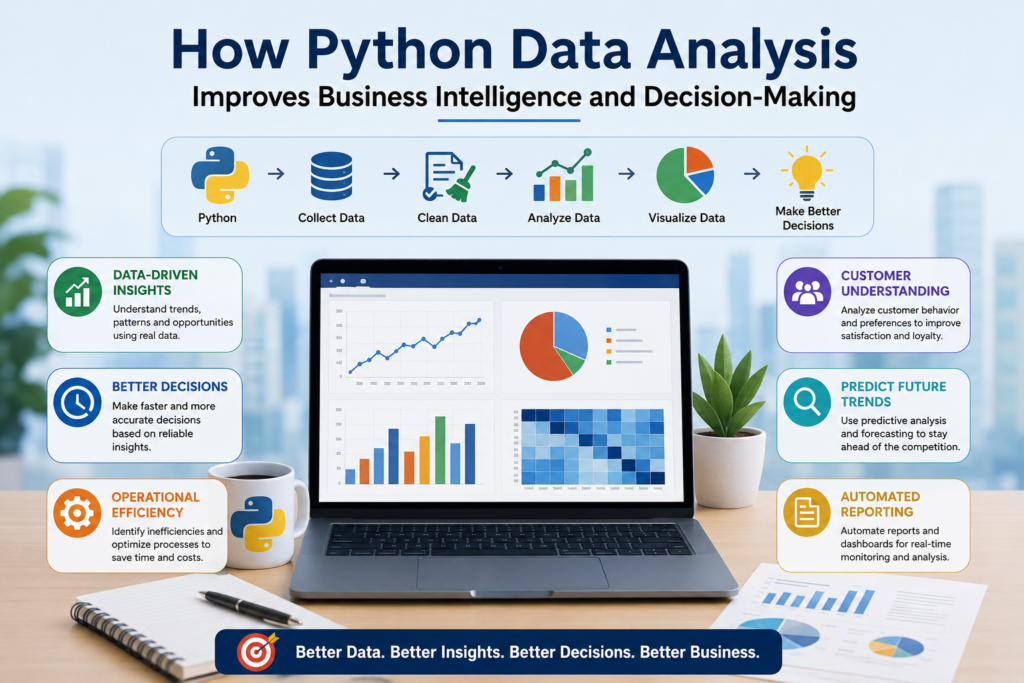
Python Data Analysis helps businesses process, organize, and interpret large volumes of data efficiently. It supports business intelligence by improving reporting, identifying trends, and helping organizations make accurate decisions based on real time insights. From forecasting sales to understanding customer behavior, Python-based analytics has become an essential part of modern business operations.
Python driven analytics can automate repetitive reporting tasks, reduce manual errors, and improve operational efficiency through faster and more reliable data interpretation.

Introduction
Modern organizations generate massive amounts of information every day through customer interactions, sales activities, digital platforms, and operational systems. However, collecting data alone is not enough. Businesses must analyze that information properly to gain useful insights and improve decision-making.
This is where Python becomes highly valuable for analytics and business intelligence. Its simple structure and powerful analytical capabilities allow organizations to manage data efficiently, identify trends, and improve overall performance.
Understanding Business Intelligence
Business intelligence refers to the process of collecting, analyzing, and presenting business information to support strategic planning and operational improvements.
Business intelligence systems are commonly used for:
- Performance monitoring
- Trend analysis
- Financial reporting
- Forecasting
- Customer insights
- Risk management
Advanced analytical tools help organizations convert raw data into meaningful business insights.
Why Python is Widely Used for Analytics
Python is one of the most preferred technologies for analytics because it combines simplicity with flexibility. It supports both beginner-level analysis and large-scale enterprise analytics projects.
Major advantages include:
- Easy-to-read syntax
- Efficient handling of large datasets
- Strong visualization support
- Automation capabilities
- Statistical analysis features
- Predictive modeling support
- Scalable analytical workflows
These features make it highly effective for business intelligence and operational analysis.
Benefits of Business Intelligence Analytics
Business Intelligence Analytics helps organizations transform raw data into meaningful insights that improve overall business performance. It supports smarter decision-making, enhances operational efficiency, and allows companies to understand customer behavior and market trends more effectively. Modern businesses rely heavily on analytics tools to improve productivity, reduce risks, and maintain long-term growth.
Faster Decision Making
Organizations can make quicker decisions with the help of real-time reports and analytics dashboards. Instead of waiting for manual reports, businesses can instantly access updated information and respond rapidly to changing situations.
Key advantages include:
- Real-time business monitoring
- Faster response to market changes
- Improved operational efficiency
- Reduced delays in decision-making
- Better management control
Improved Accuracy
Business Intelligence Analytics improves the accuracy of business reporting by reducing human errors and automating data analysis processes. Accurate insights help organizations make reliable business decisions and improve forecasting.
Important benefits are:
- Reduced manual reporting errors
- More reliable business insights
- Better forecasting and predictions
- Improved data consistency
- Higher reporting accuracy
Better Strategic Planning
Analytics helps businesses identify market trends, customer preferences, and future opportunities. Companies can use historical and real-time data to create stronger business strategies and long-term growth plans.
Strategic planning benefits include:
- Smarter business goal setting
- Better resource allocation
- Improved market analysis
- Identification of growth opportunities
- Long term business sustainability
Cost Optimization
Business Intelligence Analytics helps organizations identify inefficiencies and reduce unnecessary expenses. Businesses can monitor operations more effectively and improve resource utilization.
Major cost optimization advantages include:
- Reduced operational costs
- Better budget management
- Improved workforce efficiency
- Optimized inventory control
- Identification of wasteful spending
- Competitive Advantage
Organizations using Business Intelligence Analytics gain deeper insights into customer behavior and competitor performance. This helps businesses improve services, enhance customer satisfaction, and stay ahead in competitive markets.
Competitive benefits include:
- Better understanding of customer needs
- Improved business performance
- Faster adaptation to market trends
- Stronger competitive positioning
- Enhanced customer experience

- Poor data quality
- Large dataset management
- Security concerns
- Complex integrations
- Lack of analytical expertise
How Analytics Improves Business Decision-Making
Real Time Data Processing
Organizations often require immediate insights for faster decision-making. Real-time data analysis allows businesses to monitor activities continuously and respond quickly to market changes.
Real-time processing supports:
- Performance tracking
- Customer monitoring
- Inventory management
- Operational analysis
- Risk detection
Faster insights improve business responsiveness and efficiency.
Better Data Visualization
Visualization transforms complex datasets into understandable charts and reports. Decision-makers can understand visual insights more easily than raw numerical information.
Common visualization formats include:
- Line graphs
- Bar charts
- Heatmaps
- Pie charts
- Trend dashboards
Visualization improves communication between analysts and business teams.
Predictive Forecasting
Predictive analytics uses historical information to estimate future outcomes and trends.
Businesses use predictive models for:
- Sales forecasting
- Market trend analysis
- Demand prediction
- Financial planning
- Risk assessment
Forecasting helps organizations make more informed strategic decisions.
Customer Behavior Analysis
Understanding customer preferences and buying patterns helps businesses improve products, services, and marketing strategies.
Analytics can help organizations:
- Identify customer interests
- Track purchasing patterns
- Improve retention strategies
- Analyze engagement levels
- Enhance customer experiences
Customer focused insights strengthen long term business growth.
Operational Efficiency Improvement
Organizations use analytical techniques to identify inefficiencies and optimize workflows.
Analytics can improve:
- Resource allocation
- Supply chain performance
- Productivity monitoring
- Cost management
- Service quality
Better operational visibility supports improved business performance.
Role of Python Data Analysis in Business Intelligence
Modern business intelligence systems rely heavily on Python Data Analysis for handling structured and unstructured datasets efficiently. It helps analysts clean, process, visualize, and interpret information to support accurate reporting and smarter business strategies.
Businesses use Python Data Analysis to automate reporting workflows, improve forecasting accuracy, and build scalable analytical systems for long-term decision-making.
Industries Using Business Analytics
Finance
Financial organizations use analytics for:
- Fraud detection
- Investment planning
- Revenue forecasting
- Risk analysis
Healthcare
Healthcare analytics supports:
- Patient data management
- Medical research
- Operational planning
- Resource optimization
Retail
Retail businesses use analytics for:
- Inventory management
- Customer segmentation
- Sales tracking
- Pricing strategies
Marketing
Marketing teams analyze data to:
- Measure campaign performance
- Understand audience behavior
- Improve targeting strategies
- Track conversion rates
Manufacturing
Manufacturing industries use analytics for:
- Production monitoring
- Quality control
- Equipment maintenance
- Supply chain optimization
- Use accurate and validated datasets
- Clean data before analysis
- Automate repetitive reporting tasks
- Apply visualization for better interpretation
- Monitor business performance regularly
- Protect sensitive information
Future of Business Intelligence and Analytics
The future of analytics is becoming increasingly connected with automation, artificial intelligence, and cloud based technologies. Businesses are adopting advanced systems to improve operational efficiency and forecasting capabilities.
Future trends include:
- AI-powered analytics
- Automated reporting systems
- Real time business intelligence
- Advanced forecasting models
- Cloud based analytical platforms
As industries continue becoming more data-driven, the importance of Python Data Analysis will continue to grow in modern business environments.
Conclusion
Modern analytics has transformed the way businesses understand information and make strategic decisions. By supporting data visualization, forecasting, reporting, and operational analysis, analytical systems help organizations improve efficiency and long term performance.
Python Data Analysis continues to play an important role in business intelligence by enabling organizations to process data efficiently, automate workflows, and generate meaningful insights for smarter decision-making.
Frequently Asked Questions
Answer:
Python Data Analysis is the process of collecting, cleaning, analyzing, and visualizing business data using Python programming techniques. It helps organizations identify trends, improve reporting, and make data-driven decisions more accurately. Businesses use it to improve efficiency, forecasting, and operational performance.
Answer:
Python helps businesses process large amounts of information quickly and accurately. It supports real-time analytics, predictive forecasting, and automated reporting, which allows decision-makers to identify patterns and respond faster to market changes. This improves overall business planning and strategy.
Answer:
Python is popular because of its simple syntax, flexibility, and powerful analytical capabilities. It can handle data visualization, statistical analysis, automation, and predictive modeling efficiently. These features make it suitable for both beginners and professional analysts working with business intelligence systems.
Answer:
Many industries use Python for analytics, including finance, healthcare, retail, marketing, manufacturing, and technology. Organizations use it for forecasting, customer behavior analysis, operational monitoring, and performance optimization. Its versatility makes it useful across multiple business sectors.
Answer:
Learning Python Data Analysis helps individuals develop valuable analytical and problem-solving skills. It improves career opportunities in data analytics, business intelligence, and technology-related fields. It also enables professionals to automate workflows and make more accurate data-driven decisions.