
Data Analytics with Gen AI
How to learn Data Analytics with Gen AI?
Data analytics with Gen AI is becoming one of the most important skill combinations for modern data analysts, business analysts, and analytics learners.
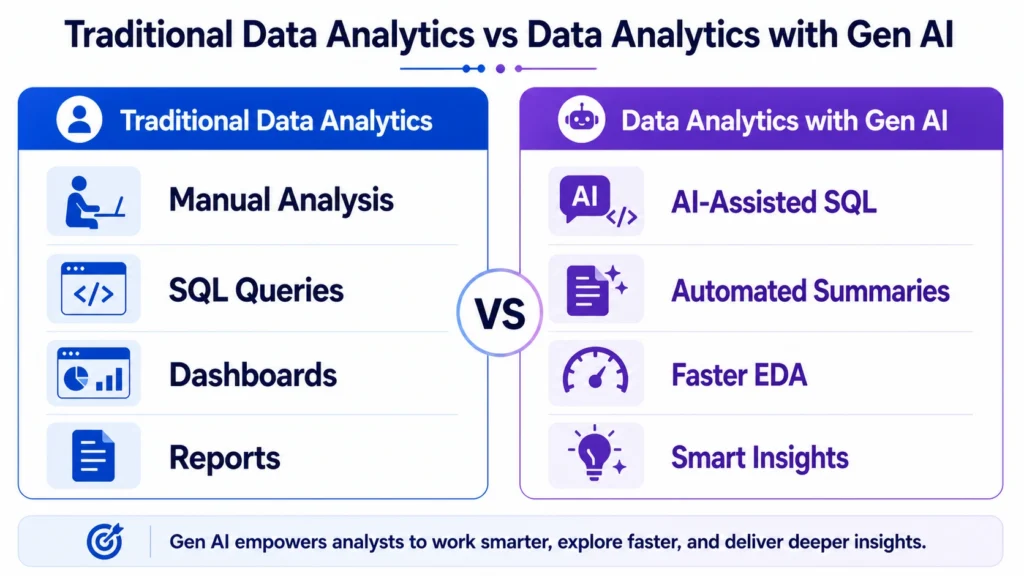
Traditional data analytics focuses on collecting, cleaning, analyzing, and visualizing data, while Generative AI helps speed up tasks like SQL query writing, report summarization, data explanation, dashboard storytelling, and insight generation.This does not mean Gen AI is replacing data analysts. Instead, it is changing the way analysts work.
What is Data Analytics with Gen AI?
Data analytics with Gen AI means using Generative AI tools and techniques to improve the overall data analytics workflow.
- It combines traditional data analysis skills with AI powered support for faster, smarter, and more efficient work.
- In a normal analytics process, analysts usually collect data, clean it, analyze patterns, create dashboards, and prepare reports.
- With Gen AI, this process becomes more efficient because AI can help in generating SQL query drafts, explaining Python errors, summarizing reports, suggesting charts, and converting technical findings into simple business insights.
Or:
“Write a SQL query to find top-performing regions by monthly revenue.”
Why Data Analytics with Gen AI is Becoming Important?
The demand for AI enabled analytics skills is increasing because businesses want faster insights from larger datasets. Generative AI is moving from experimental use to mainstream business adoption, and workforce data shows that organizations are increasingly adding AI skills into roles outside traditional tech teams as well.
India is also becoming a strong AI and analytics market. A Reuters report citing a Nasscom-BCG report stated that India’s AI market is projected to reach $17 billion by 2027, driven by enterprise technology spending, AI investments, and a growing AI talent pool.
This matters for learners because data analytics is no longer limited to dashboard creation. Modern analysts are expected to understand business problems, work with data, use visualization tools, and apply AI assisted workflows where required.
How Generative AI is Used in Data Analytics?
Generative AI can be used across different stages of the analytics lifecycle. The key is to use it as a productivity assistant, not as a blind decision maker.
1. Data Cleaning Support
- Data cleaning takes a lot of time in data analytics. Gen AI can help suggest ways to handle missing values, remove duplicates, detect inconsistencies, and even generate
- Python code for preprocessing. However, analysts must still verify whether the suggested method fits the dataset and business problem.
2. SQL Query Assistance
- Gen AI can help beginners write SQL queries, understand joins, and optimize query logic.
- For example, if the question is “Which product category had the highest profit last quarter?”, Gen AI can draft the query, but the analyst must check table names, filters, joins, and aggregations.
3. Exploratory Data Analysis
- During Exploratory Data Analysis, Gen AI can suggest variables to compare, charts to create, and patterns to investigate.
- It can speed up EDA, but the analyst still needs to validate insights with proper data understanding.
4. Dashboard and Report Writing
- Gen AI can help write dashboard summaries, KPI explanations, chart titles, and business friendly insights.
- For example, instead of simply saying “Sales increased in Q3,” it can help explain why the increase happened, making reports more useful and readable.
5. Business Insight Generation
- Gen AI can support insight generation by suggesting possible interpretations of data.
- Still, human judgment is necessary to check whether the insight is accurate, logical, and aligned with the business context.
Core Skills Required for Data Analytics using Gen AI
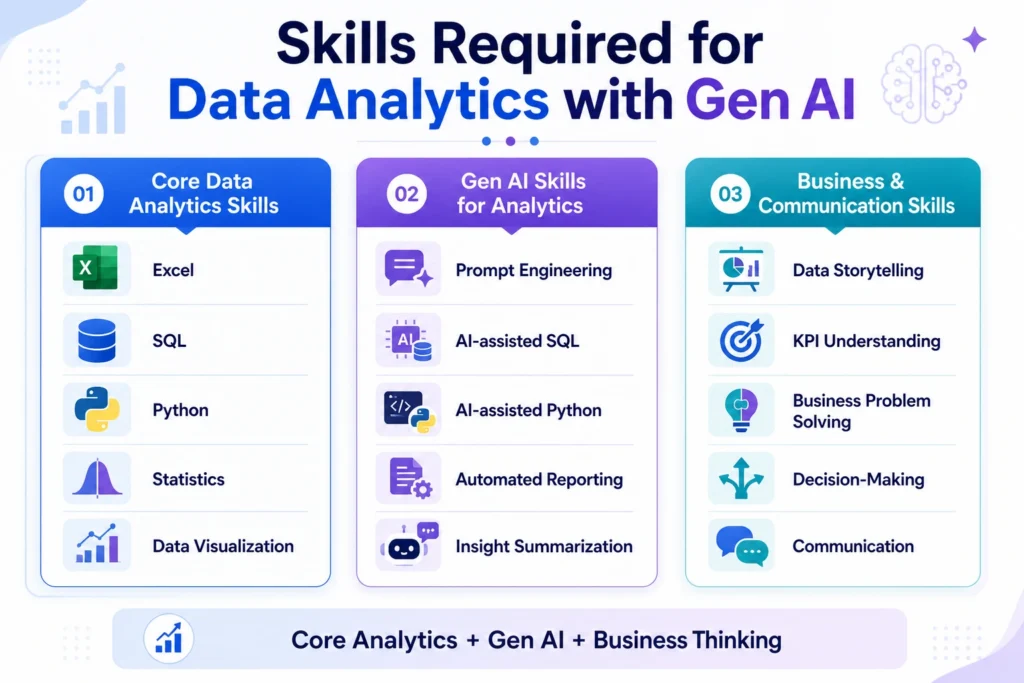
1. Excel
Excel is useful for quick analysis, reporting, pivot tables, formulas, and basic dashboards. Beginners should learn it because many businesses still use Excel for daily data work.
2. SQL
SQL helps analysts extract and analyze structured data from databases. Key skills include SELECT statements, WHERE filters, GROUP BY, JOINs, aggregations, and window functions.
3. Python
Python is used for data cleaning, automation, EDA, and basic machine learning. Important libraries include Pandas, NumPy, Matplotlib, Seaborn, and Scikit-learn.
4. Statistics
Statistics helps analysts understand patterns, distributions, correlation, probability, and uncertainty. Key concepts include mean, median, mode, standard deviation, hypothesis testing, correlation, and regression.
5. Power BI or Tableau
Power BI and Tableau help convert raw data into interactive dashboards. Analysts use them to create KPIs, apply filters, visualize trends, and present insights clearly.
6. Gen AI and Prompt Engineering
Prompt engineering means asking AI tools the right questions. In analytics, it helps with SQL queries, Python debugging, EDA suggestions, dashboard summaries, insight writing, and report automation.
7. Business Understanding
A good analyst connects data with business decisions. This includes understanding KPIs, customer behavior, revenue, costs, marketing performance, and operational efficiency.
Data Analytics with Gen AI Course Roadmap
- Data Analytics Fundamentals: Learn data basics, types of analytics, KPIs, and basic statistics.
- Excel and SQL: Practice Excel formulas, pivot tables, SQL queries, joins, filters, and aggregations.
- Python for Data Analytics: Learn Pandas, NumPy, data cleaning, EDA, and basic visualization.
- Data Visualization: Build dashboards using Power BI or Tableau with KPIs, charts, and filters.
- Machine Learning Basics: Understand regression, classification, clustering, and model evaluation.
- Generative AI for Analytics: Use Gen AI for SQL support, Python debugging, report summaries, dashboard insights, and prompt engineering.
- Projects and Case Studies: Work on sales dashboards, customer segmentation, churn analysis, and AI assisted reporting projects.
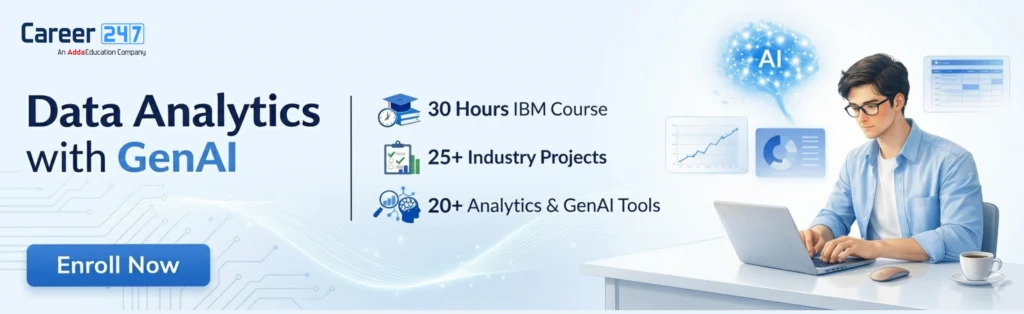
Career247’s Data Analytics using Gen AI course is one example of a structured program that combines core data analytics concepts with Gen AI workflows. It has 20+ hours of learning, Nasscom certification, flexible access, quizzes, discussions, personalized learning, and capstone projects or case studies…..
Is Gen AI Replacing Data Analysts?
No, Gen AI is not replacing data analysts completely. It is changing the role of analysts.
A data analyst still needs to:
- Understand the business problem
- Choose the right metrics
- Check data quality
- Validate AI-generated outputs
- Interpret results
- Communicate insights clearly
- Recommend practical actions
Gen AI can automate repetitive tasks, but it cannot fully replace human reasoning, domain understanding, and decision making. The best analysts will be those who can combine analytics fundamentals with AI tools responsibly.
Who Should Learn Data Analytics with Gen AI?
This skill combination is useful for:
- Students starting a data analytics career
- Freshers preparing for analyst roles
- Working professionals planning a career switch
- Business analysts upgrading their skills
- Excel users moving into analytics
- Beginners looking for a data analyst course online with certificate
- Professionals who want to become data analysts with AI skills
For beginners, the right approach is simple: learn analytics first, then use Gen AI to improve speed and productivity.
Career Scope of Data Analytics with Gen AI
Data analytics using Gen AI can support multiple career paths.
Common roles include:
- Data Analyst
- Business Analyst
- BI Analyst
- Reporting Analyst
- Junior Data Scientist
- AI enabled Data Analyst
- Analytics Consultant
Benefits of Learning Data Analytics with Gen AI
Learning this combination gives several practical benefits.
- Faster Data Analysis: Gen AI can reduce time spent on repetitive tasks like query drafting, code explanation, and report writing.
- Better Productivity: Analysts can focus more on interpretation and less on manual formatting or repetitive documentation.
- Stronger Reporting: Gen AI can help convert technical analysis into business friendly summaries.
- Better Dashboard Storytelling: AI can suggest clearer titles, explanations, and insight statements for dashboards.
- Improved Career Readiness: Learners who understand both analytics and AI workflows can build stronger portfolios for modern roles.
Future of Data Analytics with Generative AI
The future of data analytics will be more AI assisted, automated, and insight driven. Analysts will likely spend less time on repetitive reporting and more time on decision making, storytelling, and strategic analysis.
Gen AI may support:
- Natural language data exploration
- Automated dashboard summaries
- Faster data preparation
- AI assisted reporting
- Smart recommendations
- Conversational business intelligence
However, the strongest professionals will still be those who combine technical skills, data judgment, and business understanding.
So the final verdict is....
- Data analytics with Generative AI is not just a trend; it is becoming a practical skill combination for the next generation of analysts.
- Traditional data analytics skills like Excel, SQL, Python, statistics, and dashboards still remain essential, but Gen AI adds speed, automation, and smarter insight generation to the workflow.
For learners, the best path is to build strong analytics fundamentals first and then learn how to use Gen AI responsibly for real world tasks. A structured data analytics course can help simplify this journey by giving a clear roadmap, practical projects, and guided learning. Career247’s Data Analytics with Gen AI course is designed around this balanced approach, combining core data analytics concepts with Gen AI powered workflows, project based learning, and career focused skill building.
The goal should not be to depend completely on AI, but to become the kind of analyst who can use AI intelligently, validate insights confidently, and solve business problems effectively.
Frequently Asked Questions
Answer:
Data analytics with Gen AI combines traditional analytics skills like Excel, SQL, Python, statistics, and dashboards with Generative AI tools that help automate analysis, generate insights, summarize reports, and support faster decision making.
Answer:
Yes, data analytics with Generative AI is useful for beginners, but they should first learn core analytics concepts like Excel, SQL, statistics, and data visualization. Once the foundation is strong, Gen AI can help improve productivity and reporting.
Answer:
Important skills include Excel, SQL, Python, statistics, Power BI or Tableau, prompt engineering, AI assisted reporting, data storytelling, and business understanding.
Answer:
A data analytics with Generative AI course can be worth it if it teaches core analytics, practical projects, Gen AI use cases, and career ready skills. The best course should balance analytics fundamentals with modern AI workflows.
Answer:
Gen AI can automate repetitive tasks, but it cannot fully replace data analysts. Human judgment is still needed for data validation, business understanding, insight interpretation, and decision making.
Answer:
Common tools include Excel, SQL, Python, Power BI, Tableau, AI assistants, prompt engineering tools, and AI powered analytics platforms.