
Categorical Variables in Machine Learning
Categorical Variables in Machine Learning
One Hot Encoding vs Label Encoding
Categorical variables in machine learning represent data that is grouped into categories such as gender, city, product type, or department. Since machine learning algorithms work with numerical data, these categorical values must be converted into a numerical format before model training.
This is where encoding techniques come into play. The most commonly used methods are One Hot Encoding vs Label Encoding, and choosing the right approach is crucial for model accuracy and performance. Understanding the difference between these two techniques helps in avoiding common mistakes and improving predictive results.

What are Categorical Variables in Machine Learning?
Categorical variables are features that represent qualitative or non numerical data.
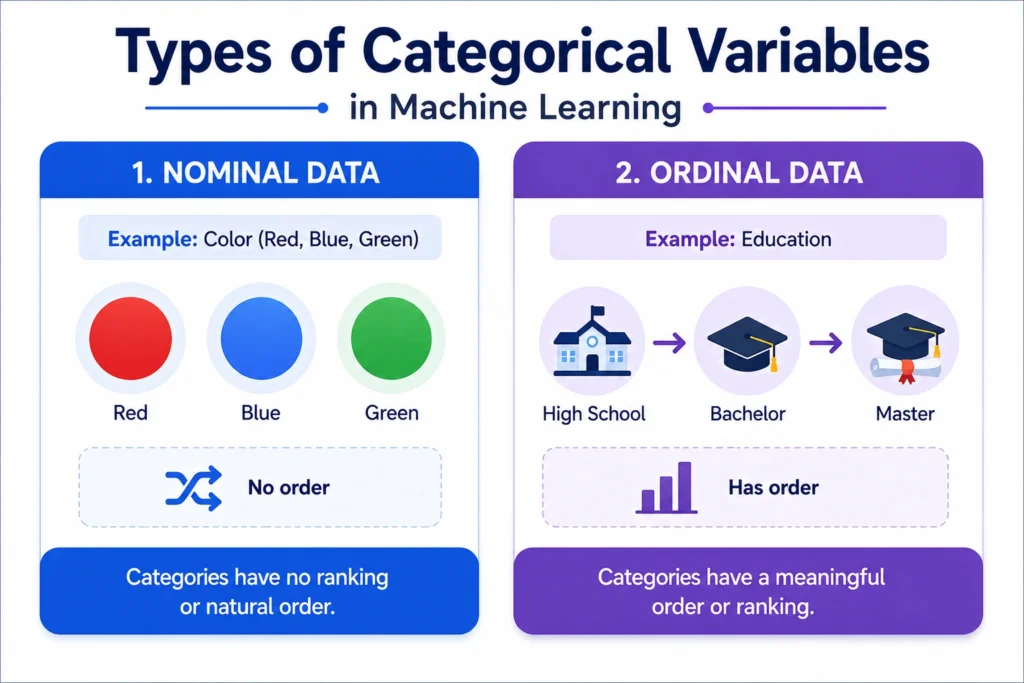
Types of Categorical Variables:
1. Nominal Variables: No specific order
Example: Colors (Red, Blue, Green)
2. Ordinal Variables: Have a meaningful order
Example: Education Level (High School < Bachelor < Master)
Why Encoding is Required
Machine learning models cannot directly process text based categorical values.
Key reasons:
- Convert categories into numerical form
- Enable mathematical calculations
- Improve model performance
- Help algorithms detect patterns effectively
What is Label Encoding?
Label encoding converts categorical values into numeric labels.
When to Use Label Encoding:
- When data is ordinal
- When categories have meaningful ranking
Limitations:
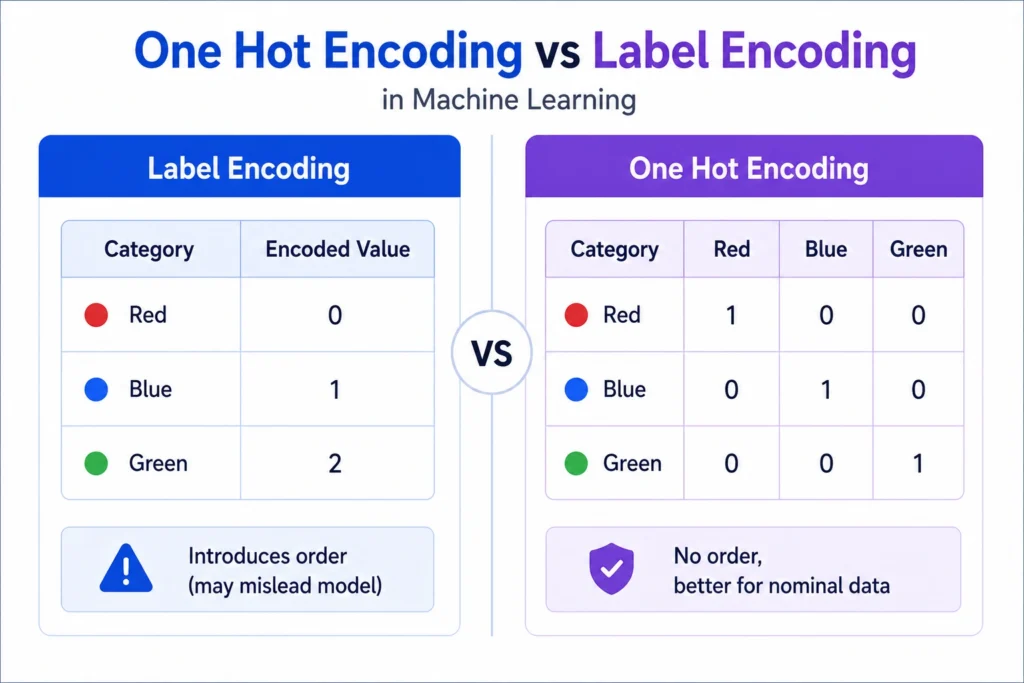
- Introduces false order for nominal data
- Can mislead models like regression or KNN
Example:
| Category | Encoded Value |
|---|---|
| Red | 0 |
| Blue | 1 |
| Green | 2 |
What is One Hot Encoding?
One hot encoding converts categories into multiple binary columns.
When to Use One Hot Encoding:
- When data is nominal
- When categories have no order
Limitations:
- Increases number of features
- Can lead to high dimensionality
Example:
| Color | Red | Blue | Green |
|---|---|---|---|
| Red | 1 | 0 | 0 |
| Blue | 0 | 1 | 0 |
| Green | 0 | 0 | 1 |
One Hot Encoding vs Label Encoding: What’s the Difference?
Before choosing a method, it is important to understand One Hot Encoding vs Label Encoding in machine learning.
- Label Encoding assigns a unique number to each category
- One Hot Encoding creates separate binary columns for each category
The choice depends on whether the categorical data has an order or not.

Practical Implementation of Categorical Variables
Label Encoding Example:
from sklearn.preprocessing import LabelEncoder

data = ['Red', 'Blue', 'Green', 'Blue']
encoder = LabelEncoder()

encoded = encoder.fit_transform(data)
print(encoded)
One Hot Encoding Example:
import pandas as pd

data = pd.DataFrame({'Color': ['Red', 'Blue', 'Green']})

encoded = pd.get_dummies(data)
print(encoded)
Real World Example of Categorical Variables
Consider a dataset with a “City” column:
- Mumbai
- Delhi
- Bangalore
Using label encoding:
Mumbai = 0, Delhi = 1, Bangalore = 2
Using one hot encoding:
Each city becomes a separate column
Common Mistakes in One Hot Encoding vs Label Encoding
- Using label encoding for nominal variables
- Applying one hot encoding on high cardinality data
- Ignoring dummy variable trap
- Encoding before splitting the dataset
Impact on Machine Learning Models
Proper handling of categorical variables in machine learning helps:
- Improve model accuracy
- Prevent bias in predictions
- Ensure correct feature interpretation
- Enhance overall performance
Choosing between One Hot Encoding vs Label Encoding directly affects how well the model learns patterns.
Conclusion….
Handling categorical variables in machine learning is a crucial step in data preprocessing.
- Techniques like One Hot Encoding vs Label Encoding help convert categorical data into a numerical format that machine learning models can understand.
- While label encoding is suitable for ordered data, one hot encoding is ideal for unordered categories.
- Choosing the right encoding method ensures better model performance, avoids misleading relationships, and improves prediction accuracy.

Frequently Asked Questions
Answer:
Categorical variables in machine learning are non numerical data types that represent categories such as color, gender, or location.
Answer:
One Hot Encoding vs Label Encoding refers to two techniques used to convert categorical data into numerical format. Label encoding assigns numbers, while one-hot encoding creates binary columns.
Answer:
Use one hot encoding for nominal data and label encoding for ordinal data where categories have a natural order.
Answer:
Encoding is important because machine learning algorithms require numerical input to process and learn from data.
Answer:
Yes, one hot encoding increases the number of features, which can lead to higher dimensionality.