
Real Time Analytics Platform in Big Data
Real Time Analytics Platform in Big Data
In the age of big data, businesses and organizations need to process large volumes of data quickly to make real time decisions. This is where a real time analytics platform in big data comes into play. It helps in analysing data as soon as it is created or collected, providing insights that drive timely actions.
In this article, we will explore the key aspects of a real time analytics platform in big data and discuss why it is crucial for businesses today.

What is a Real Time Analytics Platform in Big Data?
A real time analytics platform in big data is a system designed to process and analyze data as it flows into the system. Unlike traditional analytics methods that work on historical data, real time analytics focuses on streaming data, providing businesses with immediate insights. This enables organizations to act fast based on the latest information available.
- Sensitive data must be protected and comply with privacy regulations.
- Access control ensures data is only available to authorized users.
- Data should be encrypted during transmission to prevent breaches.
- Real time security threats must be detected and mitigated immediately.
- Ensuring data integrity is critical for accurate analytics.
Essential Features of a Real Time Analytics Platform in Big Data
A good real time analytics platform in big data comes with several important features:
- High Speed Data Processing
The primary function of a real time analytics platform is its ability to handle high speed data processing. With big data coming in at high volumes, the platform must be capable of ingesting and analyzing it without delays. Technologies like Apache Kafka, Apache Flink, and Apache Spark are commonly used in these platforms to ensure data is processed in real time. - Data Integration
A real time analytics platform should seamlessly integrate with various data sources, whether they come from IoT devices, social media, web interactions, or enterprise systems. Integration ensures that the platform can pull in data from all these sources and process them together. - Scalability
As the amount of data grows, the real time analytics platform should scale accordingly. The platform must be able to handle increasing volumes of data, often by utilizing distributed computing technologies. This scalability is essential for large organizations that deal with massive amounts of data. - Real Time Dashboards
A real time analytics platform typically includes dashboards that display insights in real time. These dashboards allow decision makers to visualize key metrics and performance indicators instantly, helping them make informed decisions right away. - Data Storage
In a real time analytics platform data storage must be optimized for speed and performance. Traditional relational databases are often not suitable due to their slower response times. Instead, NoSQL databases and distributed file systems like Hadoop and cloud based storage solutions are commonly used.
Benefits of a Real Time Analytics Platform in Big Data
Implementing a real time analytics platform in big data offers several key benefits:
- Faster Decision Making
One of the main advantages of a real time analytics platform is the speed at which decisions can be made. Businesses can quickly analyze live data and take immediate action, whether it’s responding to customer feedback, monitoring supply chain operations, or reacting to changes in the market. - Improved Customer Experience
By using a real time analytics platform businesses can enhance the customer experience. For example, e-commerce platforms can offer personalized recommendations or promotions based on real time user behavior. - Operational Efficiency
With the insights provided by a real time analytics platform businesses can streamline their operations. By monitoring key metrics and processes in real time, they can identify inefficiencies and optimize workflows. - Competitive Advantage
Businesses that use a real time analytics platform can gain a competitive edge by responding faster to trends and changes in the market. Real time insights allow businesses to adapt quickly, which is a significant advantage in today’s fast paced business environment.

- Latency issues delay insights and impact decision making.
- High data throughput is essential for handling large scale streams.
- Real time data should be processed continuously, not in batches.
- Data quality issues can affect the reliability of real time insights.
- Infrastructure must scale to handle growing data volumes.
Challenges in Real Time Analytics Platform in Big Data
While the benefits are clear, implementing a real time analytics platform in big data also comes with challenges:
Data Overload:
The vast amount of data coming in from various sources social media, sensors, devices, or logs can be overwhelming. Identifying and filtering out irrelevant or low priority data is a continual challenge, making it harder to focus on actionable insights. Too much data can dilute the value of critical information, leading to “analysis paralysis.”
Complexity:
Setting up a real time analytics platform involves numerous layers of technology data ingestion, storage, processing, and visualization. The complexity increases when dealing with unstructured data, multiple data sources, or differing data formats. This requires specialized knowledge and constant upkeep to ensure the system remains functional and up to date.
Latency Issues:
Even in real time systems, latency can cause delays, particularly when large volumes of data need to be processed simultaneously. Processing time may be affected by network bandwidth, data transmission delays, or the inability of the infrastructure to handle spikes in data flow. This can compromise the timeliness of the insights needed for decision making.
Data Quality and Consistency:
Data quality issues, such as missing values, incorrect data, or duplicates, can significantly affect the reliability of real time insights. Ensuring the integrity and consistency of data is an ongoing process, requiring constant monitoring and cleansing techniques, particularly as data sources change over time.
Scalability:
As the volume and complexity of data grow, real time analytics platforms must scale efficiently. This scalability is not just about handling more data, but also accommodating faster data streams without degrading performance. Managing horizontal scaling (more servers) and vertical scaling (more processing power) is a key challenge in these systems.
Integration with Existing Systems:
Often, real time analytics platforms need to integrate with legacy data systems, third party APIs, or existing enterprise platforms. These integrations can be tricky because of differing technologies, incompatible data formats, or the lack of real time capabilities in older systems. Without smooth integration, data inconsistencies or delays can occur, undermining the effectiveness of the platform.
Real Time Data Processing:
Processing unstructured and semi structured data (e.g., text, images, or video) in real time requires substantial computational power and advanced algorithms. Big data frameworks like Apache Kafka or Hadoop can help, but these require constant tuning and optimization to maintain performance under heavy load.
Security and Privacy:
Real time data platforms often handle sensitive or private data, which increases the risk of data breaches. Implementing effective encryption, secure data transfer protocols, and adhering to privacy regulations such as GDPR or CCPA is essential. Ensuring that the platform is both secure and compliant with laws adds another layer of complexity.
Data Storage and Management:
Storing massive amounts of real time data requires specialized storage solutions, such as distributed databases or cloud storage. Managing this data ensuring it’s accessible, cost effective, and properly indexed can be difficult. Decisions about whether to store data in raw form or as aggregated summaries also add to the challenge.
High Operational Costs:
The need for robust hardware, specialized software, and skilled personnel results in high operational costs. Real time analytics platforms require constant monitoring, tuning, and maintenance. As more data is generated and processed, the costs of storage, processing power, and bandwidth increase, requiring businesses to allocate more resources.
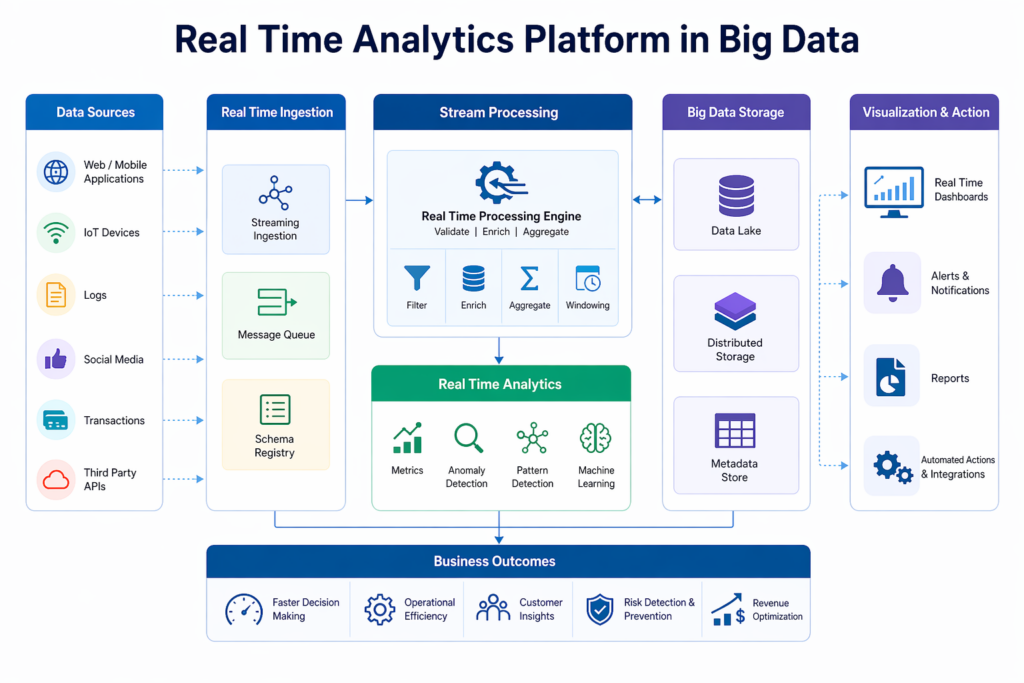
Understanding Types of Real Time Analytics in Big Data
In today’s digital era, businesses are leveraging real time analytics to make data driven decisions instantly. A real time analytics platform processes incoming data streams without delay, providing immediate insights for organizations across various industries. This enables faster decision making, enhances operational efficiency, and improves customer experiences.
Types of Real Time Analytics
There are three primary types of real time analytics that organizations use based on their needs:
- Descriptive Analytics:- Focuses on summarizing real-time data to provide insights into what is happening at the moment. This type is commonly used in dashboards and live monitoring systems.
- Predictive Analytics:- Uses machine learning and historical data to forecast future trends or behaviors in real time. For example, financial institutions leverage this to detect fraudulent transactions instantly.
- Prescriptive Analytics:- Suggests actions based on real-time insights. AI driven recommendations, such as dynamic pricing in e-commerce or automated resource allocation in supply chains, fall under this category.
The ability to utilize these types of real time analytics efficiently depends on robust infrastructure, scalable data pipelines, and powerful processing technologies like Apache Kafka and Spark Streaming.
Frequently Asked Questions
Answer:
A Real Time Analytics Platform in Big Data is a system that processes and analyzes data instantly as it is generated. It helps businesses gain immediate insights without delays. This enables faster decision-making and improves operational efficiency. Such platforms are widely used in finance, e-commerce, and healthcare.
Answer:
Real-time analytics is important because it allows organizations to react instantly to changing data. It helps detect trends, anomalies, and opportunities as they happen. This leads to better customer experience and faster business responses. Companies can stay competitive by making timely, data-driven decisions.
Answer:
A real-time analytics platform collects streaming data from multiple sources like sensors, apps, or websites. It processes this data using high-speed tools and algorithms. The results are then visualized through dashboards or alerts. This continuous flow ensures up-to-date insights at all times.
Answer:
Key features include real-time data processing, scalability, low latency, and data visualization. These platforms also support integration with multiple data sources. They provide instant alerts and automated insights. Such features make them essential for handling large-scale, fast-moving data.
Answer:
Real-time analytics helps improve decision-making speed and accuracy. It enhances customer engagement by providing personalized experiences instantly. Businesses can detect fraud, monitor systems, and optimize operations in real time. Overall, it increases efficiency and drives better business outcomes.