
Model Planning for Data Analytics
Model Planning for Data Analytics
Model Planning for Data Analytics is a crucial phase that focuses on creating a clear and structured approach for analyzing data. It ensures that the right techniques, tools, and methods are selected to generate accurate and meaningful insights. A well-defined model plan helps improve decision-making, increases efficiency, and supports better business outcomes.
Effective model planning involves defining objectives, selecting appropriate data methods, and aligning analysis with business goals, ensuring reliable and actionable insights.

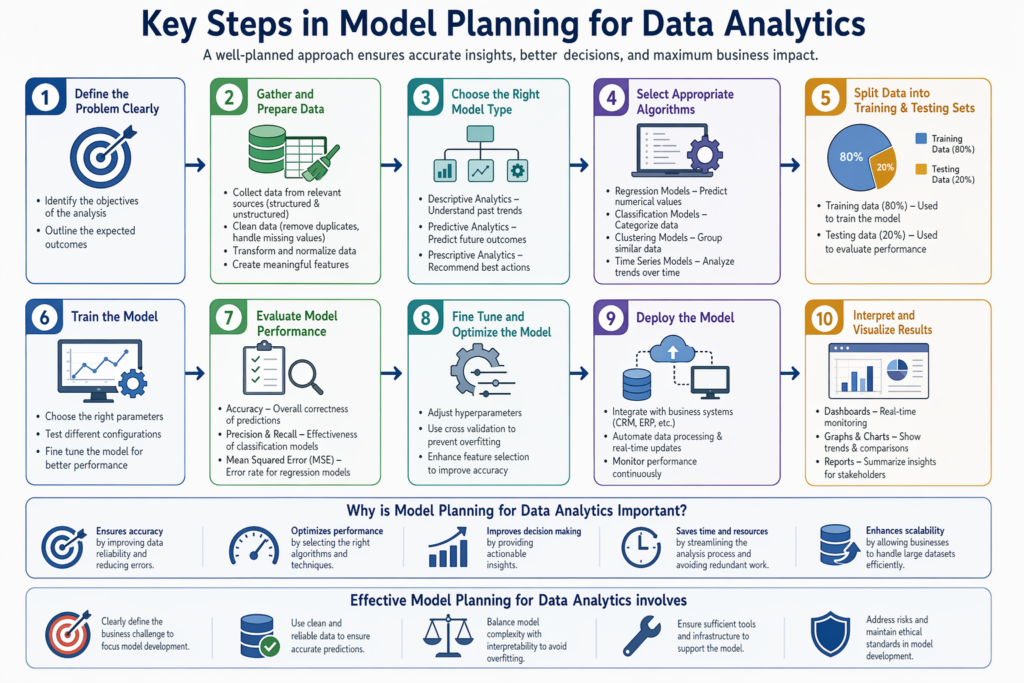
Key Steps in Model Planning for Data Analytics
1. Define the Problem Clearly
Before starting any data analysis, it is crucial to define the business problem clearly. Without a well defined objective, the analysis may become directionless, leading to inaccurate insights and wasted resources. This step involves:
- Identifying the Objectives of the Analysis:- What is the primary goal of the data analysis? Is it to increase customer retention, improve product recommendations, or optimize supply chain efficiency? Clearly defining the objective ensures the right data is collected and the appropriate analytical approach is chosen.
- Outlining the Expected Outcomes:- Having a clear expectation of the results helps in validating the model. It also assists in measuring whether the analysis was successful or if modifications are needed.
By thoroughly defining the problem, businesses can align their data analytics approach with strategic goals, ensuring meaningful and actionable results.
2. Gather and Prepare Data
Once the problem is defined, the next step is to collect and prepare data. This stage is critical because poor data quality can significantly impact the accuracy of the final model.
Data Collection
Data can come from various sources, and it is crucial to identify the most relevant and reliable ones. Sources can include:
- Structured Data:- Stored in databases, spreadsheets, or customer relationship management (CRM) systems. Examples include sales records, customer demographics, and financial transactions.
- Unstructured Data:- Text data from social media, emails, sensor data from IoT devices, images, and videos. Advanced analytics techniques like Natural Language Processing (NLP) are often required to extract useful insights.
Data Cleaning
Once the data is collected, it must be cleaned to ensure accuracy and consistency. This involves:
- Removing duplicate records that can distort analysis.
- Handling missing values by either filling them with estimated values or removing incomplete records.
- Correcting inconsistencies in formats, such as date formats, measurement units, and categorical variables.
Data Transformation and Normalization
Raw data is often not in the right format for analysis. Transformation and normalization techniques help in:
- Converting categorical data into numerical formats for machine learning models.
- Normalizing numerical features to ensure consistent scale.
- Creating new meaningful variables (feature engineering) that improve model performance.
Data preparation is time consuming but essential, as high quality data leads to better model accuracy and reliability.
3. Choose the Right Model Type
Selecting the right model type is a crucial step in Model Planning for Data Analytics. Different models are designed for different analytical tasks, and choosing the wrong one can lead to misleading conclusions.
Types of Analytics Models
- Descriptive Analytics:- Focuses on analyzing historical data to identify trends and patterns. Examples include sales reports, customer purchase behavior, and website traffic analysis.
- Predictive Analytics:- Uses historical data and machine learning algorithms to forecast future outcomes. Examples include predicting customer churn, stock prices, and demand forecasting.
- Prescriptive Analytics:- Not only predicts future outcomes but also suggests the best actions to take. It is used in applications like personalized marketing, fraud detection, and automated decision making.
Understanding the type of analysis needed ensures that the right approach is selected.
4. Select Appropriate Algorithms
The choice of algorithm depends on the problem statement and the type of data available.
Common Algorithms Used in Data Analytics
- Regression Models:- Used for predicting numerical values. Example Linear regression predicts sales based on advertising spend.
- Classification Models:- Used for categorizing data into predefined groups. Example Spam detection in emails (spam or not spam).
- Clustering Models:- Groups similar data points together. Example Customer segmentation based on purchasing behavior.
- Time Series Models:- Analyzes trends over time. Example Predicting electricity consumption based on historical usage data.
Choosing the right algorithm ensures that the data model is accurate, interpretable, and aligned with the business objective.
5. Split Data into Training and Testing Sets
To validate the model’s performance, the dataset is typically divided into two parts:
- Training Data (80%):- Used to train the model. It learns from this data to recognize patterns.
- Testing Data (20%):- Used to evaluate the model’s ability to generalize to new data.
Splitting data helps in avoiding overfitting, where the model performs well on training data but fails on real world scenarios.

- Ensures accuracy by improving data reliability and reducing errors.
- Optimizes performance by selecting the right algorithms and techniques.
- Improves decision making by providing actionable insights.
- Saves time and resources by streamlining the analysis process and avoiding redundant work.
- Enhances scalability by allowing businesses to handle large datasets efficiently.
6. Train the Model
Training the model involves feeding it with data so it can learn patterns and relationships. This requires:
- Choosing the Right Parameters:- Each model has adjustable parameters that impact performance. Selecting the right combination improves accuracy.
- Testing Different Configurations:- Running different versions of the model and comparing results helps in selecting the best approach.
- Fine Tuning the Model:- Adjusting hyperparameters and feature selection optimizes the model for better performance.
Well trained models are crucial for generating accurate predictions and meaningful insights.
7. Evaluate Model Performance
- Once the model is trained, its performance must be assessed using key metrics:
Accuracy:- Measures the overall correctness of predictions. - Precision & Recall:- Evaluate the effectiveness of classification models, especially in imbalanced datasets.
- Mean Squared Error (MSE):- Measures the error rate of regression models.
Regular evaluation ensures that the model remains effective over time.
8. Fine Tune and Optimize the Model
To further improve performance, fine tuning is necessary. This includes:
- Adjusting hyperparameters to improve efficiency.
- Using cross validation techniques to prevent overfitting.
- Enhancing feature selection to improve prediction accuracy.
Optimization ensures that the model delivers the best possible results.
9. Deploy the Model
After validation, the model is deployed into production. Deployment involves:
- Integration with Business Systems:- Connecting the model with CRM, ERP, or other software applications.
- Automation of Data Processing:- Ensuring real time updates for continuous analysis.
- Ongoing Monitoring:- Regularly checking performance to detect any issues or changes in accuracy.
Successful deployment allows organizations to leverage analytics for strategic decision making.
10. Interpret and Visualize Results
Communicating insights effectively is just as important as analyzing the data. Visualization tools help make complex data easy to understand.
Common Visualization Techniques
- Dashboards:- Provide real time monitoring of key metrics.
- Graphs and Charts:- Show trends, comparisons, and distributions.
- Reports:- Summarize findings for stakeholders in a structured format.
Effective visualization enhances decision making by presenting data in a clear and actionable manner.
- Clearly define the business challenge to focus model development.
- Use clean and reliable data to ensure accurate predictions.
- Balance model complexity with interpretability to avoid overfitting.
- Ensure sufficient tools and infrastructure to support the model.
- Address risks and maintain ethical standards in model development.
Best Practices for Model Planning for Data Analytics
Effective Model Planning for Data Analytics is crucial for achieving accurate and reliable insights. By following best practices, businesses can ensure their data models perform optimally and provide valuable information for decision making.
Below are the key best practices for successful model planning.
1. Understand the Data
Before selecting a model, it is essential to gain a thorough understanding of the dataset. Without this step, even the most advanced analytics models may not yield meaningful insights.
- Identify the source of the data (e.g., customer transactions, social media, surveys).
- Determine whether the data is structured (e.g., databases) or unstructured (e.g., images, text).
- Analyze the distribution of data and check for outliers that might affect results.
- Understand the relationships between different variables to identify patterns and trends.
By understanding the dataset, analysts can make informed decisions about Model Planning for Data Analytics and choose the best approach for problem solving.
2. Select the Right Algorithm
Choosing the right algorithm is one of the most important aspects of Model Planning for Data Analytics. The type of algorithm selected depends on the nature of the problem.
- Regression Algorithms:- Used for predicting continuous values, such as sales forecasts.
- Classification Algorithms:- Useful for categorizing data into specific groups, like spam detection in emails.
- Clustering Algorithms:- Groups similar data points, such as customer segmentation based on purchasing behavior.
- Time Series Algorithms:- Analyzes trends over time, such as predicting electricity consumption.
Selecting the right algorithm ensures that the model is well-suited to the problem and improves accuracy.
3. Ensure Data Quality
Poor data quality can significantly impact the performance of an analytics model. Cleaning and preparing the data before model training is essential to avoid inaccurate results.
- Remove duplicate entries that can distort insights.
- Handle missing values by either filling them with estimated values or removing incomplete records.
- Normalize and transform the data to ensure consistency across different variables.
- Standardize formats (e.g., date, currency, measurement units) to avoid inconsistencies.
Proper data quality management is a foundational step in Model Planning for Data Analytics that directly impacts the reliability of the model.
4. Use Feature Engineering
Feature engineering is the process of selecting and transforming relevant data points to improve model performance. This step enhances the model’s ability to identify meaningful patterns and relationships.
- Identify the most important features that influence the outcome.
- Create new features by combining existing variables (e.g., calculating total sales per customer).
- Remove irrelevant or redundant features to simplify the model.
- Use domain knowledge to improve the quality of input data.
Feature engineering plays a critical role in making Model Planning for Data Analytics more effective and ensures that the model can generate better predictions.
5. Monitor Performance Regularly
Once a model is deployed, continuous monitoring is necessary to maintain accuracy and efficiency.
- Regularly test the model against new data to detect any performance changes.
- Track key performance metrics such as accuracy, precision, recall, and mean squared error.
- Make adjustments as needed by fine-tuning hyperparameters and updating the dataset.
- Use automation to retrain models periodically and adapt to changing trends.
Monitoring performance ensures that Model Planning for Data Analytics remains relevant and continues to deliver valuable insights over time.
- Poor Data Quality leads to inaccurate conclusions due to incomplete or incorrect data.
- Overfitting occurs when a model performs well on training data but poorly on new data.
- Selecting the Wrong Model results in ineffective analysis and unreliable insights.
- Ignoring Business Context causes the model to misalign with business objectives, leading to meaningless results.
Model Planning for Data Analytics is a crucial step in ensuring accurate, reliable, and actionable insights. By following a structured approach defining the problem, preparing data, selecting the right model, and evaluating performance businesses can optimize their analytics process.
Implementing best practices and addressing challenges will help organizations maximize the potential of Model Planning for Data Analytics and achieve data driven success.

Frequently Asked Questions
Answer:
Model planning is the process of designing how data will be analyzed to solve a specific problem. It involves selecting techniques, tools, and methods to ensure accurate and meaningful results.
Answer:
It provides a clear direction for analysis, reducing errors and saving time. A well-planned model improves decision-making and ensures reliable insights from data.
Answer:
Key steps include defining the problem, selecting variables, choosing analytical techniques, and determining evaluation metrics. These steps help structure the analysis effectively.
Answer:
The choice depends on the type of data and the problem being solved. Factors like data size, complexity, and expected outcomes play a major role.
Answer:
Common tools include spreadsheets, statistical software, and programming languages. These tools help organize data, test models, and visualize results.
Answer:
Challenges include unclear objectives, poor data quality, and incorrect model selection. Addressing these issues is essential for accurate and useful insights.
Answer:
A data analyst course teaches skills like data cleaning, visualization, and statistical analysis. It helps learners understand how to extract insights from data.
Answer:
Anyone interested in working with data, including students and professionals, can take this course. Basic knowledge of math and computers is helpful but not always required.
Answer:
You learn data handling, analysis techniques, visualization, and problem-solving. These skills help in interpreting data and making informed decisions.
Answer:
The duration varies depending on the course type. It can range from a few weeks to several months based on depth and learning pace.