
Data Analytics Courses
Best Data Analytics Courses....
Guide to Choose the Right Course for Your Career
Data analytics courses are designed to help learners build the technical, analytical, and business skills needed to work with data professionally. As companies increasingly depend on data to make decisions, the demand for skilled data analysts is growing across industries such as IT, finance, healthcare, retail, marketing, and consulting.

What are Data Analytics Courses?
Data analytics courses are structured training programs that teach learners how to work with data and extract useful insights from it. These courses usually cover both theoretical concepts and practical tools used in real world analytics jobs.
A professional data analytics course generally includes:
- Excel for data analysis
- SQL for database querying
- Python for analytics
- Statistics and probability
- Data cleaning and preprocessing
- Data visualization
- Business intelligence tools
- Dashboard creation
- Real world projects
- Interview and portfolio preparation
The goal of these courses is not only to teach tools but also to help learners understand how data supports business decision making.
Why Choose a Career in Data Analytics?
Data analytics is one of the most practical and career oriented fields today because almost every company generates data. Businesses need professionals who can convert raw data into meaningful insights.
Main reasons to choose data analytics:
- High Demand Across Industries: Data analysts are needed in finance, healthcare, e-commerce, education, marketing, logistics, consulting, and IT.
- Strong Career Growth: With experience, a data analyst can move into roles like business analyst, BI analyst, data scientist, analytics manager, or product analyst.
- Good Salary Potential: Data analytics roles offer strong salary growth, especially for candidates who know SQL, Python, Excel, Tableau, Power BI, and business analytics.
- Practical and Skill Based Career: Unlike purely theoretical fields, data analytics is highly practical. Your projects, dashboards, and problem solving skills matter a lot.
- Suitable for Beginners and Career Switchers: A well structured data analyst course can help learners from non technical or semi technical backgrounds enter the analytics field step by step.
Who Should Enroll in a Data Analytics Course?
A data analytics course is suitable for:
- Students planning to enter analytics or business intelligence
- Fresh graduates looking for job-ready skills
- Working professionals switching careers
- Marketing, finance, HR, or operations professionals who want analytics skills
- Beginners who want a structured roadmap
- Professionals looking for a data analyst certification
- Learners who want practical exposure through projects
If you are confused about how to become data analyst, the right course can provide a clear roadmap, tool based learning, projects, and guidance.
Skills Covered in Data Analytics Courses
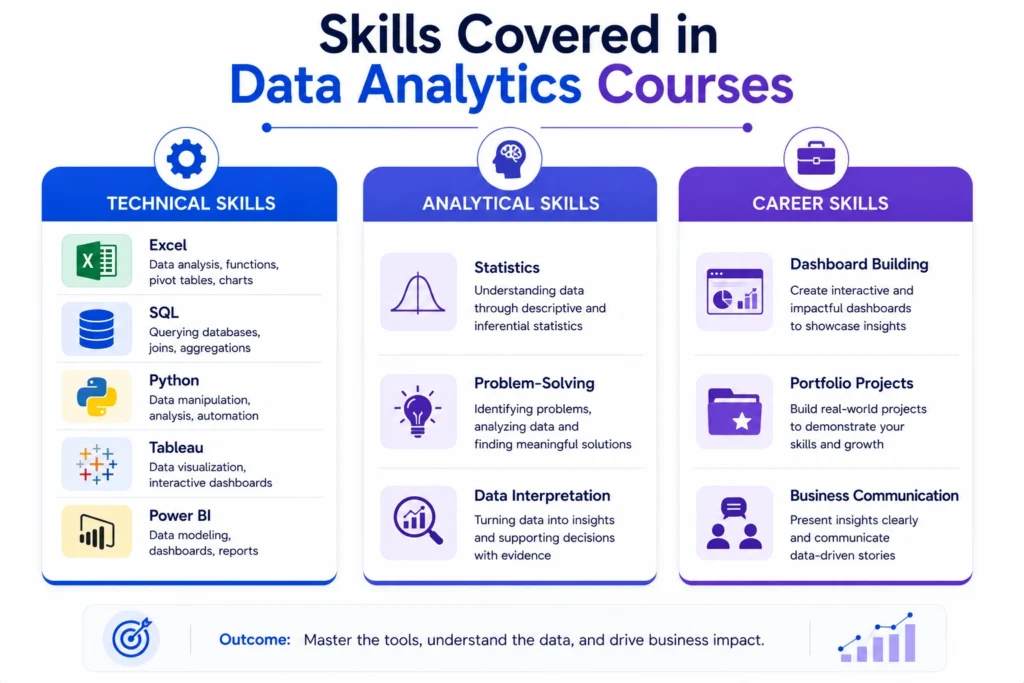
A good data analytics course should cover a balance of tools, concepts, and business problem solving.
Technical Skills:
- Excel for reporting and spreadsheet analysis
- SQL for querying databases
- Python for data cleaning and analysis
Tableau or Power BI for visualization - Statistics for data interpretation
- Data preprocessing and transformation
- Dashboard creation
Analytical Skills:
- Logical thinking
- Pattern recognition
- Data interpretation
- Problem solving
- Business understanding
- Insight generation
Communication Skills: Data analysts must explain insights clearly. A good course should also help learners understand how to present findings through dashboards, reports, and storytelling with data.
Popular Tools Taught in Data Analytics Courses
Most data analytics courses focus on industry relevant tools.
- Excel: Excel is used for basic data analysis, formulas, pivot tables, charts, and quick reporting. It is often the first tool beginners learn.
- SQL: SQL is essential for extracting, filtering, joining, and analyzing data stored in databases. It is one of the most important skills for data analyst roles.
- Python: Python is used for data cleaning, automation, advanced analysis, and machine learning basics. Libraries like Pandas, NumPy, Matplotlib, and Seaborn are commonly used.
- Tableau and Power BI: These tools help create interactive dashboards and business intelligence reports. They are widely used for visual reporting and stakeholder presentations.
- Statistics: Statistics helps analysts understand data behavior, probability, distributions, hypothesis testing, correlation, and regression.
What Should the Best Data Analytics Courses Include?
The best data analytics courses should not only teach concepts but also help learners apply them in practical business scenarios.
A strong course should include:
- Beginner friendly curriculum
- Excel, SQL, Python, Tableau or Power BI
- Statistics and business analytics concepts
- Real world datasets
- Hands on projects
- Dashboard building practice
- Case studies
- Resume and interview support
- Certification after completion
- Portfolio building guidance
A course that only teaches theory may not be enough. Learners should focus on practical implementation, because employers value hands on experience.
Data Analytics Course Fees: What to Expect?
Data analytics course fees can vary depending on the platform, duration, certification, mentorship, and project support.
Generally, the fee depends on:
- Course duration
- Live or recorded classes
- Certification value
- Tools covered
- Number of projects
- Mentor support
- Career guidance
- Placement or interview preparation
A short self paced course may cost less, while a full professional data analyst course online with certificate may cost more because it includes structured learning, projects, mentorship, and career support.
While comparing data analyst course fees, learners should not only look at price. They should check whether the course provides practical learning, real projects, dashboard exposure, and career preparation.
Online vs Offline Data Analytics Courses
Both online and offline data analytics courses can be useful, but the right choice depends on your schedule, learning style, budget, and career goals.
| Factor | Online Data Analytics Courses | Offline Data Analytics Courses |
|---|---|---|
| Learning Flexibility | High flexibility; learn from anywhere | Fixed schedule and location |
| Best For | Students, working professionals, career switchers | Learners who prefer classroom learning |
| Access to Classes | Recorded/live sessions can be revisited | Usually limited to classroom sessions |
| Cost | Often more affordable and scalable | Can be higher due to classroom setup |
| Practical Projects | Available if the course is well-structured | Depends on institute and trainer |
| Doubt Support | Through live sessions, chat, or mentor calls | Face-to-face support |
| Certification | Usually includes online certificate | Usually includes institute certificate |
| Career Support | Depends on platform; may include resume/interview help | Depends on institute |
| Convenience | No travel required | Requires travel and fixed attendance |
For most modern learners, a data analyst course online with certificate is practical because it offers flexibility, structured learning, recorded access, and project based practice. Offline courses can still be useful for learners who prefer physical classroom interaction and fixed discipline.
The best choice is not simply online or offline. The best choice is the course that provides a strong curriculum, practical projects, recognized certification, mentor support, and career focused guidance.
Certification in Data Analytics: Why It Matters
A data analytics certification helps validate your learning and improves your professional profile. It shows that you have completed structured training and gained knowledge of analytics tools and techniques.
A data analyst certification is useful for:
- Freshers building credibility
- Career switchers entering analytics
- Professionals upgrading skills
- Learners applying for internships or entry level roles
Certifications like IBM data analytics certification or other professional credentials can add value, especially when combined with strong projects and a portfolio.
However, certification alone is not enough. Your ability to solve business problems using data is what makes you job-ready.
Career247 Data Analytics Course: A Practical Learning Option
For learners looking for a structured and career focused path, Career247’s Data Analytics Course is designed to help beginners and professionals build job-ready analytics skills.
The course focuses on:
- Excel, SQL, Python, and Tableau
- Data cleaning and analysis
- Business intelligence concepts
- Dashboard creation
- Real world projects
- Guided learning and mentorship
- Career focused preparation
Career Opportunities After Data Analytics Courses
After completing a good data analytics course, learners can apply for roles such as:
- Data Analyst
- Junior Data Analyst
- Business Analyst
- BI Analyst
- Reporting Analyst
- Marketing Analyst
- Operations Analyst
- Product Analyst
Entry level learners should focus on projects, SQL practice, dashboards, and communication skills to improve job readiness.
Conclusion….
Data analytics courses help learners build the skills needed to work with data professionally. A good course should teach tools like Excel, SQL, Python, Tableau or Power BI, along with statistics, dashboards, real-world projects, and business problem-solving.
- For anyone planning to enter the analytics field, choosing the right course is important.
- Certification adds value, but practical skills, portfolio projects, and the ability to explain insights clearly are what make you job ready.
- The best approach is to choose a course that offers structured learning, hands on practice, recognized certification, and career focused guidance.
With consistent effort and the right training, data analytics can become a strong career path for students, freshers, and working professionals.
Frequently Asked Questions
Answer:
Data analytics courses are structured programs that teach learners how to collect, clean, analyze, visualize, and interpret data using tools like Excel, SQL, Python, Tableau, and Power BI.
Answer:
The best data analytics course for beginners is one that covers fundamentals, Excel, SQL, Python, statistics, visualization, real world projects, and career guidance in a structured way. Learners should also look for recognized certification, mentor support, and portfolio building practice. For a guided option, Career247’s Data Analytics Course can be considered because it is IBM and NASSCOM certified and focuses on practical, job-ready learning.
Answer:
Data analytics course fees vary depending on duration, certification, mentorship, tools covered, projects, and career support.
Answer:
Yes, a data analyst course online with certificate is useful for learners who want flexibility, structured learning, and professional credibility. It helps beginners learn tools like Excel, SQL, Python, and Tableau while working on practical projects. A course like Career247’s Data Analytics Course adds value because it combines online learning, real-world projects, and IBM plus NASSCOM certification to support career-focused skill building.
Answer:
Important skills include Excel, SQL, Python, statistics, data visualization, dashboard creation, problem-solving, and business understanding.
Answer:
It is not mandatory, but a data analytics certification can improve your profile and validate your learning, especially for beginners and career switchers.