
Splitting data into Training and Testing sets
Training and Testing Sets in Machine Learning
Splitting data into training and testing sets in machine learning is a fundamental step in building accurate and reliable models. In real world data analytics and machine learning workflows, datasets are divided into different subsets so that a model can learn from one portion and be evaluated on another.
This ensures that the model does not simply memorize the data but instead learns patterns that generalize well to unseen data.

What is Data Splitting in Machine Learning?
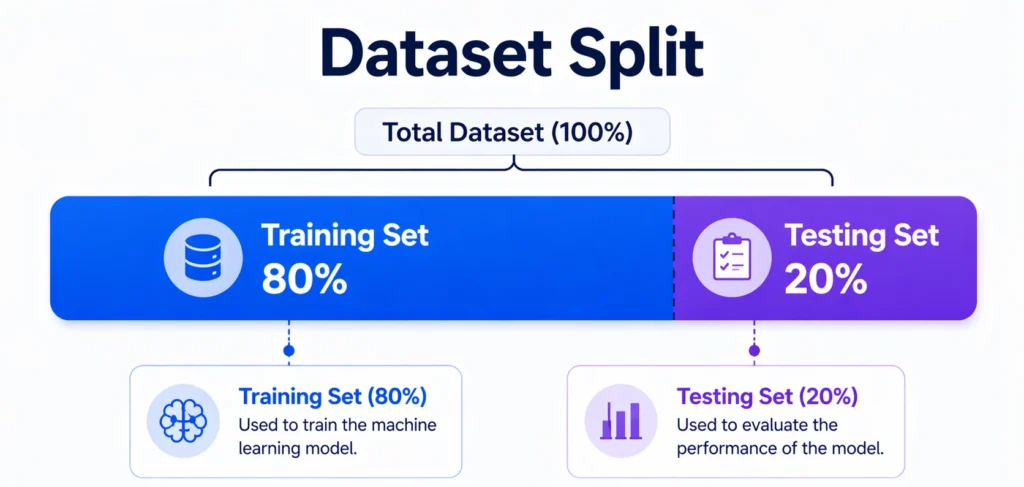
Data splitting is the process of dividing a dataset into separate subsets, mainly:
- Training Set → Used to train the model
- Testing Set → Used to evaluate the model
In many cases, a third subset called the validation set is also used to fine tune model parameters. So in short it means Training data teaches the model and Testing data checks how well the model learned.
Why Splitting Data is Important?
1. Prevents Overfitting
If a model is trained and tested on the same data, it may memorize patterns rather than learn them. This leads to overfitting.
2. Evaluates Real Performance
Testing data helps measure how the model performs on unseen data, giving a realistic performance estimate.
3. Ensures Model Generalization
A well trained model should work on new data, not just the data it has seen.
4. Supports Model Optimization
Validation sets allow tuning hyperparameters for better performance.
5. Builds Reliable Machine Learning Systems
Proper splitting ensures that results are trustworthy and models are production-ready.
Types of Data Splitting
1. Training Set:
- Typically 70–80% of total data
- Used for learning patterns
- Helps model understand relationships
2. Testing Set:
- Typically 20–30% of total data
- Used for final evaluation
- Never used during training
3. Validation Set:
- Used for tuning model parameters
- Helps select the best model
- Common in advanced ML workflows
Difference between Training, Testing and Validation Sets
| Aspects | Training Sets | Testing Sets | Validation Sets |
|---|---|---|---|
| Purpose | Used to train the mode. | Used to evaluate the model’s performance on unseen data | Used to tune model hyper parameters and assess performance during training |
| Data Usage | Model learns patterns and relationships from this set. | Model predictions are compared to actual results to assess accuracy | Helps in adjusting the model’s settings without influencing training directly |
| Data Proportion | 70-80% of the total data.(commonly) | 20-30% of the total data (commonly) | Typically 10-20% of the total data if used |
| Examples | Holdout, K-Fold Cross-Validatio. | Holdout, K-Fold Cross-Validation | K-Fold Cross-Validation, Early Stopping |
| Key Consideration | Ensures that the model has enough data to learn pattern. | Used to simulate how the model performs on real-world, unseen data | Helps in fine-tuning model hyper parameters, ensuring better generalization |
| Overfitting Risk | Low if the training data is diverse enough. | Moderate if the model is too simple or over fitted to the training data | Low as the validation set does not overlap with the training data |
| Impact on Model Evaluation | Direct impact on how well the model learns and fits to data. | Direct impact on how the model generalizes to new data | Indirect impact, but helps refine and prevent over fitting |

Methods for Splitting Data into Training and Testing Sets
1. Random Splitting
- Data is randomly divided
- Most commonly used method
- Works well for general datasets
2. Stratified Splitting
- Maintains class distribution
- Important for classification problems
Example: If dataset has 70% class A and 30% class B → same ratio maintained
3. Time Based Splitting
- Used for time series data
- Data is split chronologically
Example: Past data → training and Future data → testing.
Practical Implementation in Python
from sklearn.model_selection import train_test_split
import pandas as pd

# Sample dataset
data = {
    'Feature1': [1,2,3,4,5,6,7,8,9,10],
    'Target': [0,1,0,1,0,1,0,1,0,1]
}

df = pd.DataFrame(data)

X = df[['Feature1']]
y = df['Target']

# Split dataset
X_train, X_test, y_train, y_test = train_test_split(
    X, y, test_size=0.2, random_state=42
)

print("Training Data:\n", X_train)
print("Testing Data:\n", X_test)
What this code does:
- Splits data into 80% training and 20% testing
- Ensures reproducibility using random_state
- Separates features and target variables
Real World Example of Splitting Data:
Consider a banking dataset used for fraud detection:
- Total records: 50,000
- Training set: 40,000
- Testing set: 10,000
The model learns patterns from historical transactions and is then tested on unseen transactions to predict fraud. This ensures the model works effectively in real world scenarios.
Advanced Concept: Cross Validation
Cross validation improves model evaluation by splitting data multiple times.
K Fold Cross Validation: Dataset divided into K parts and Model trained and tested K times.
- Example: 5-fold cross validation → dataset split into 5 parts
- Benefits: More reliable performance metrics and Reduces bias and Better model evaluation.
1. Accurate model evaluation
2. Reduced overfitting
3. Better generalization
4. Reliable predictions
Conclusion….
Splitting data into training and testing sets in machine learning is a crucial step that ensures models are trained effectively and evaluated accurately.
- By dividing datasets into separate subsets, machine learning models can learn patterns from training data and be tested on unseen data, ensuring real world reliability.
- Techniques such as random splitting, stratified sampling, and cross validation further enhance model performance and evaluation.
Mastering data splitting is essential for building robust, accurate, and production ready machine learning models.

Frequently Asked Questions
Answer:
It is the process of dividing a dataset into separate subsets to train and evaluate machine learning models.
Answer:
It helps evaluate model performance on unseen data and prevents overfitting.
Answer:
Common ratios are 80:20 or 70:30, depending on dataset size and use case.
Answer:
Training data is used to build the model, while testing data evaluates its performance.
Answer:
Cross validation is a technique that splits data multiple times to provide more reliable model evaluation.