
Levels of Measurement in Data Analytics
Levels of Measurement – Nominal, Ordinal, Interval, Ratio Scale
Understanding the levels of measurement is fundamental in statistics and research. These levels help us classify and analyze data based on its characteristics.
The four main levels of measurement are nominal, ordinal, interval, and ratio. Each level has unique properties that dictate how we can use and interpret the data.

What are the 4 levels of measurement of data?
Levels of measurement refer to the different ways in which data can be classified and analyzed. They determine how we can interpret the data and what statistical methods can be applied. The four levels are:
- Nominal Level
- Ordinal Level
- Interval Level
- Ratio Level
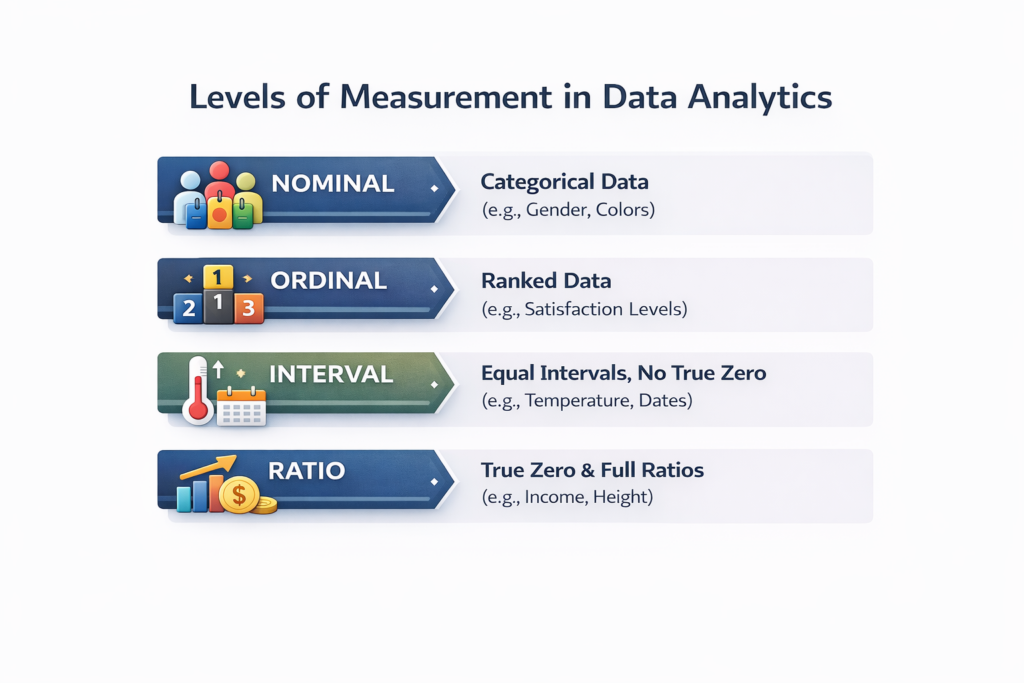
1. Nominal Level
The nominal level is the simplest form of measurement. Data at this level is categorized into distinct groups or labels without any inherent order or ranking.
Key Features:
- Data is qualitative, not quantitative.
- Categories are mutually exclusive and exhaustive.
- There is no meaningful numerical value or order.
Examples:
- Gender (Male, Female, Non-Binary)
- Colors (Red, Blue, Green)
- Types of Cuisine (Italian, Chinese, Indian)
Note – Nominal data is primarily used for labeling and classification. Since there is no order, arithmetic operations cannot be performed on this type of data.
2. Ordinal Level
Ordinal measurement adds a sense of order or rank to the data. However, the differences between the ranks are not uniform or measurable.
Key Features:
- Data is qualitative or ranked.
- Categories follow a logical order.
- The intervals between ranks are not equal or defined.
Examples:
- Education Level (High School, Bachelor’s, Master’s, PhD)
- Customer Satisfaction Ratings (Poor, Average, Good, Excellent)
- Contest Rankings (1st, 2nd, 3rd)
Note – Although ordinal data provides a sense of progression, it does not indicate the magnitude of differences between ranks. For example, the gap between “Good” and “Excellent” may vary greatly compared to “Poor” and “Average.”

3. Interval Level
The interval level introduces measurable differences between data points. Unlike ordinal data, the intervals in this level are equal and consistent, but there is no true zero point.
Key Features:
- Data is quantitative.
- Intervals between values are consistent and meaningful.
- Lacks a true zero point, meaning ratios cannot be calculated.
Examples:
- Temperature in Celsius or Fahrenheit
- IQ Scores
- Calendar Years (e.g., 2000, 2023)
Note – With interval data, you can perform arithmetic operations like addition and subtraction. However, you cannot make statements like “this value is twice as much as another” because of the absence of a true zero.
4. Ratio Level
The ratio level is the most advanced and precise level of measurement. It includes all the properties of the interval level, with the addition of a true zero point, allowing for meaningful ratio comparisons.
Key Features:
- Data is quantitative.
- Has a true zero point (complete absence of the measured quantity).
- Allows for all mathematical operations, including multiplication and division.
Examples:
- Height (in cm or inches)
- Weight (in kg or pounds)
- Time (in seconds, minutes, or hours)
- Income (in dollars or rupees)
Note – Because ratio data includes a true zero, you can say things like “this object is twice as heavy as that object.”
Why Are Levels of Measurement Important?
Understanding the levels of measurement is essential because:
Final Thoughts
Understanding the levels of measurement – nominal, ordinal, interval, and ratio – is essential for effective data analysis in various fields. Each level provides different insights and requires specific statistical methods for analysis. By recognizing these distinctions, researchers can select appropriate techniques to analyze their data accurately and draw meaningful conclusions.

Frequently Asked Questions
Answer:
The Levels of Measurement in Data Analytics refer to the different ways data can be classified and used for analysis. There are four main levels: Nominal, Ordinal, Interval, and Ratio. These levels help analysts decide which statistical techniques to apply and how to interpret data correctly.
Answer:
The Levels of Measurement in Data Analytics are important because they determine what type of calculations and statistical analysis can be performed. For example, nominal data can only be categorized, while ratio data allows advanced mathematical operations like averages and percentages.
Answer:
In the Levels of Measurement in Data Analytics, nominal data is the most basic type of data used for labeling or categorization without any order. Examples include gender, country, or product categories. This type of data cannot be measured numerically.
Answer:
In the Levels of Measurement in Data Analytics, ordinal data has a meaningful order or ranking, unlike nominal data. For example, customer satisfaction ratings (good, better, best) show order but do not show the exact difference between ranks.
Answer:
In the Levels of Measurement in Data Analytics, interval data has equal spacing between values but no true zero (like temperature in Celsius), while ratio data has both equal intervals and a true zero (like height or weight). Ratio data allows comparison using ratios.
Answer:
Understanding the Levels of Measurement in Data Analytics helps analysts select appropriate statistical methods. For instance, nominal data uses mode, ordinal data uses median, and interval or ratio data can use mean and standard deviation for deeper analysis.