
Difference between Descriptive and Inferential statistics
Difference between Descriptive and Inferential statistics
Statistics is a branch of mathematics that deals with collecting, analyzing, interpreting, presenting, and organizing data. It helps in making sense of complex data sets and provides tools for decision-making based on data insights. In statistics, there are two main types: descriptive statistics and inferential statistics. Understanding the difference between these two types is crucial for anyone working with data.

What is Statistics?
Statistics is the science of collecting and analyzing numerical data to understand trends, patterns, and relationships.
- It provides methods for summarizing data and making predictions or inferences based on that data.
- By using statistical techniques, we can draw conclusions from a sample of data that can be generalized to a larger population.
Types of Statistics
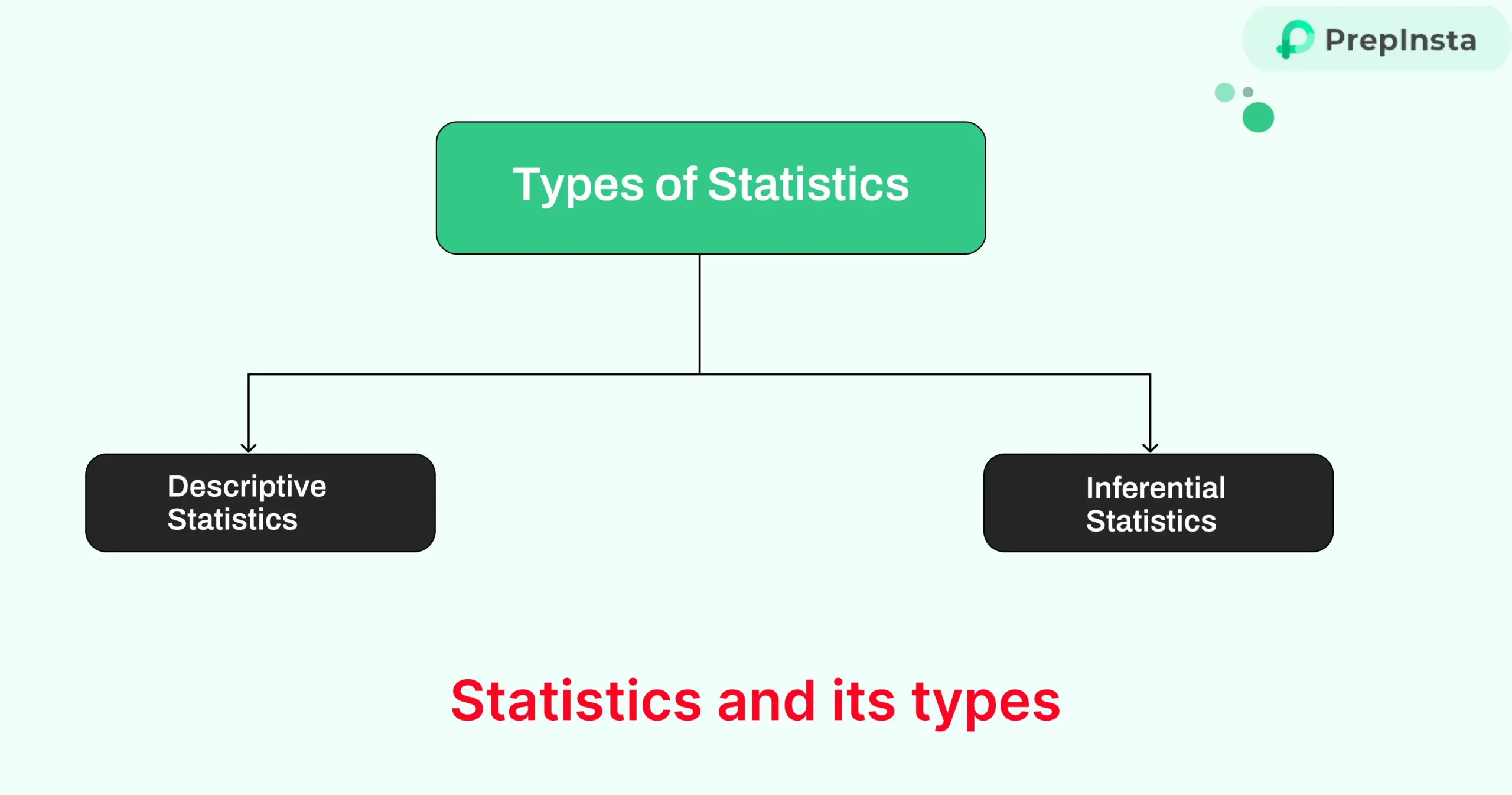
Statistics can be broadly classified into two categories:
- Descriptive Statistics: This type summarizes and describes the features of a dataset. It provides simple summaries about the sample and the measures.
- Inferential Statistics: This type makes inferences and predictions about a population based on a sample of data drawn from that population.
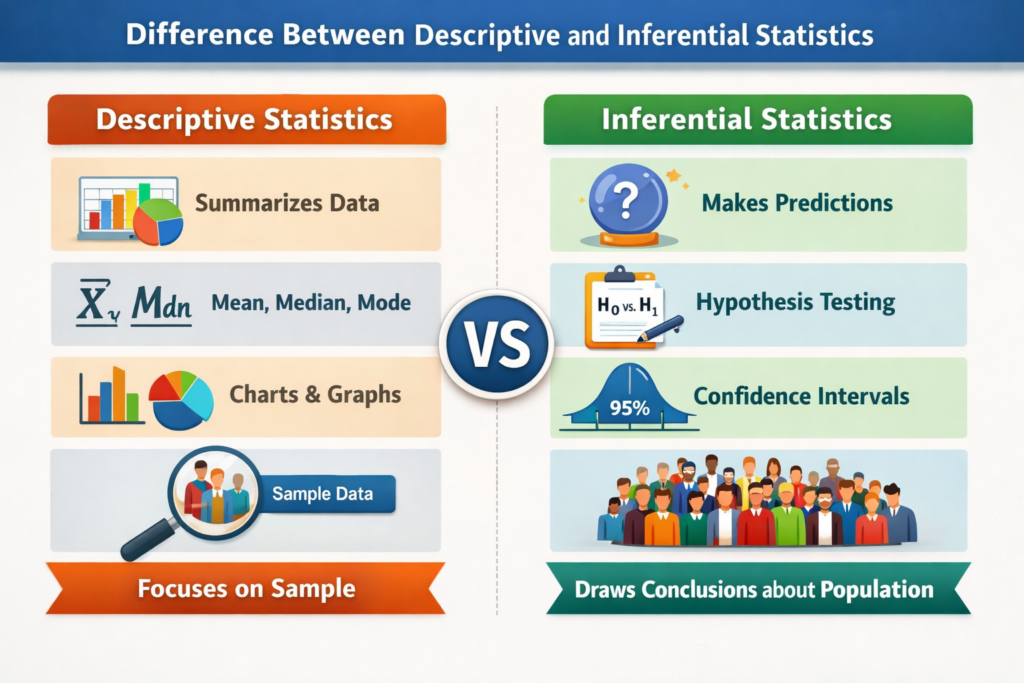
Difference between Descriptive and Inferential Statistics
The primary distinction between descriptive and inferential statistics lies in their purpose:
| Aspect | Descriptive Statistics | Inferential Statistics |
|---|---|---|
| Definition | Summarizes and describes the characteristics of a dataset. | Makes inferences and predictions about a population based on a sample. |
| Purpose | To provide a clear summary of data. | To draw conclusions and make generalizations about a population. |
| Data Type | Works with actual data from the sample. | Works with sample data to infer about the larger population. |
| Techniques Used | Measures of central tendency, measures of dispersion, graphical representations. | Estimation, hypothesis testing, regression analysis. |
| Examples | Mean, median, mode, range, variance, histograms. | Confidence intervals, t-tests, ANOVA, linear regression. |
| Outcome | Provides insights into the dataset itself. | Provides insights that extend beyond the dataset to the population. |
| Applications | Used for summarizing data in reports and presentations. | Used in research studies, market analysis, and scientific experiments. |

Use Cases of Descriptive Statistics
Use Cases of Inferential Statistics
Applications of Descriptive Statistics
- Descriptive statistics are widely used in various fields such as business, healthcare, education, and social sciences to summarize information quickly and effectively.
- They help in understanding the basic features of data before applying more complex statistical analyses.
Applications of Inferential Statistics
- Inferential statistics are crucial in fields like market research, clinical trials, quality control, and social science research.
- They allow for making informed decisions without needing complete information about an entire population.
Final Thoughts
In summary, both descriptive and inferential statistics play vital roles in data analysis. Descriptive statistics provide insights into the characteristics of a dataset, while inferential statistics enable predictions about larger populations based on sample data. Understanding these differences is essential for anyone looking to understand the power of data effectively.

Frequently Asked Questions
Answer:
The main difference between Descriptive and Inferential Statistics is their purpose. Descriptive statistics summarizes and organizes data using measures like mean, median, and charts, while inferential statistics uses sample data to make predictions, estimates, or generalizations about a larger population.
Answer:
Examples of Descriptive Statistics include mean, median, mode, variance, and data visualization techniques like bar charts and pie charts.
Examples of Inferential Statistics include hypothesis testing, regression analysis, confidence intervals, and probability distributions. These methods help explain the practical difference between Descriptive and Inferential Statistics.
Answer:
The purpose of Descriptive Statistics is to describe the main features of a dataset. The purpose of Inferential Statistics is to draw conclusions and make predictions based on sample data. Understanding this helps clarify the difference between Descriptive and Inferential Statistics in data analysis.
Answer:
Descriptive statistics should be used when you want to summarize or present data clearly. Inferential statistics should be used when you want to make predictions or test hypotheses. Knowing when to use each explains the real-world difference between Descriptive and Inferential Statistics.
Answer:
In data analytics, descriptive statistics is used to analyze historical data and identify patterns, while inferential statistics is used to forecast trends and support decision-making. Both are important to understand the difference between Descriptive and Inferential Statistics in practical data analytics applications.
Answer:
Yes, both Descriptive and Inferential Statistics work together in the data analysis process. Descriptive statistics helps in understanding the data, while inferential statistics helps in making predictions. This combined use highlights the complete difference between Descriptive and Inferential Statistics.