
Inheritance in Java

Inheritance in Java
Inheritance is a mechanism that allows us to extend the definition of a class without making any physical changes to the existing class.
Inheritance creates a new class from an existing class. Any new class that we create from an existing class is called a derived class, and an existing class is called a base class.
Concept and Types of inheritance
The inheritance relationship enables a derived class to inherit features from its base class. A derived class can add new features of its own. Therefore rather than creating completely new classes from scratch, we can take advantage of inheritance and reduce software complexity.
- Class: A class is a group of objects which have common properties. It is a template or blueprint from which objects are created.
- Sub Class/Child Class: Subclass is a class that inherits the other class. It is also called a derived class, extended class, or child class.
- Super Class/Parent Class: Superclass is the class from where a subclass inherits the features. It is also called a base class or a parent class.
- Reusability: As the name specifies, reusability is a mechanism that facilitates you to reuse the fields and methods of the existing class when you create a new class. You can use the same fields and methods already defined in the previous class.
Types of inheritance :
- Single Inheritance
- Multiple Inheritance
- Hierarchical Inheritance
- Multilevel Inheritance
- Hybrid Inheritance
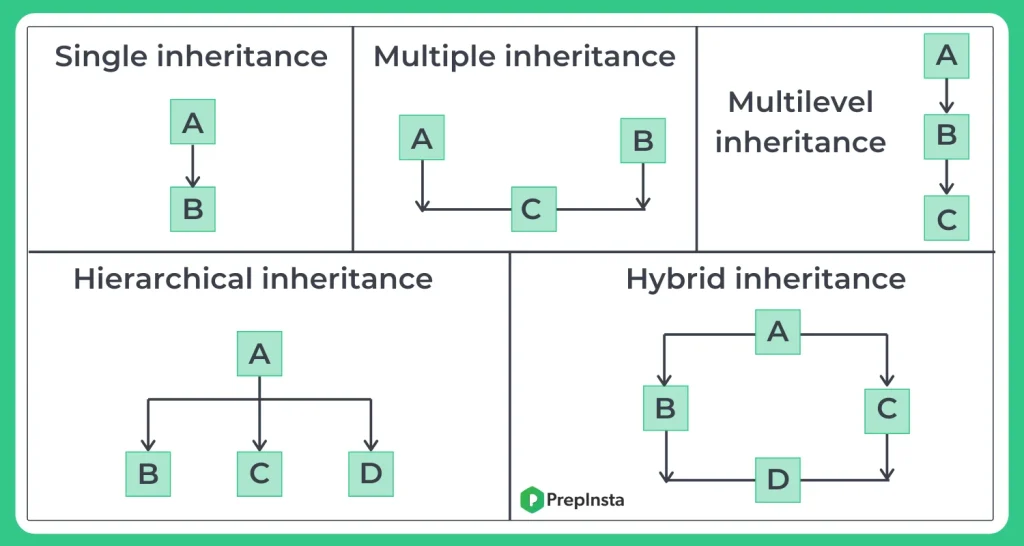
1. Single Inheritance
It is the inheritance hierarchy wherein one derived class inherits from one base class.
2. Multiple Inheritance
It is the inheritance hierarchy wherein one derived class inherits from multiple base classes.
3. Hierarchical Inheritance
It is the inheritance hierarchy wherein multiple derived classes inherit from one base class.
4. Multilevel Inheritance
It is the inheritance hierarchy wherein subclass acts as a base class for other classes.
5. Hybrid Inheritance
It is the inheritance hierarchy that reflects any legal combination of the other four types of inheritance
Syntax
class XYZ extends ABC
  {
       // block of code
  }
Example
class Bicycle
{
	// the Bicycle class has two fields
	public int gear;
	public int speed;

	// the Bicycle class has one constructor
	public Bicycle(int gear, int speed)
	{
		this.gear = gear;
		this.speed = speed;
	}

	// the Bicycle class has three methods
	public void applyBrake(int decrement)
	{
		speed -= decrement;
	}

	public void speedUp(int increment)
	{
		speed += increment;
	}

	// toString() method to print info of Bicycle
	public String toString()
	{
		return("No of gears are "+gear
				+"\n"
				+ "speed of bicycle is "+speed);
	}
}

// derived class
class MountainBike extends Bicycle
{

	// the MountainBike subclass adds one more field
	public int seatHeight;

	// the MountainBike subclass has one constructor
	public MountainBike(int gear,int speed,
						int startHeight)
	{
		// invoking base-class(Bicycle) constructor
		super(gear, speed);
		seatHeight = startHeight;
	}

	// the MountainBike subclass adds one more method
	public void setHeight(int newValue)
	{
		seatHeight = newValue;
	}

	// overriding toString() method
	// of Bicycle to print more info
	@Override
	public String toString()
	{
		return (super.toString()+
				"\nseat height is "+seatHeight);
	}

}

// driver class
public class Test
{
	public static void main(String args[])
	{

		MountainBike mb = new MountainBike(3, 100, 25);
		System.out.println(mb.toString());

	}
}
Output
No. of gears are 3

The speed of bicycle is 100

Seat height is 25
Prime Course Trailer
Related Banners
Get PrepInsta Prime & get Access to all 200+ courses offered by PrepInsta in One Subscription
Get over 200+ course One Subscription
Courses like AI/ML, Cloud Computing, Ethical Hacking, C, C++, Java, Python, DSA (All Languages), Competitive Coding (All Languages), TCS, Infosys, Wipro, Amazon, DBMS, SQL and others
Inheritance in Python
Inheritance in Python:
Inheritance in Python is the capability of one class to derive or inherit the properties from another class. In inheritance, the child class acquires the properties and can access all the data members and functions defined in the parent class. A child class can also provide its specific implementation to the functions of the parent class.
Example:
- Class A:
//pass
Class B(A):
//pass

Benefits of Inheritance:
- Reusability of code.
- We can use the features of the other class, without modifying it.
- It is transitive in nature i.e. A->B->C == A->C and B->C.
Syntax:
class Parentclass_name:

 ##statement

class child_class(Parentclass_name):

  ##statement
Different forms of Inheritance:
- Single inheritance: When a child class inherits from only one parent class, it is called single inheritance.
Code #1:
- Multiple inheritance: When a child class inherits from multiple parent classes, it is called multiple inheritance
Code #2:
Output:
A
B
C
PrepInsta Prepster
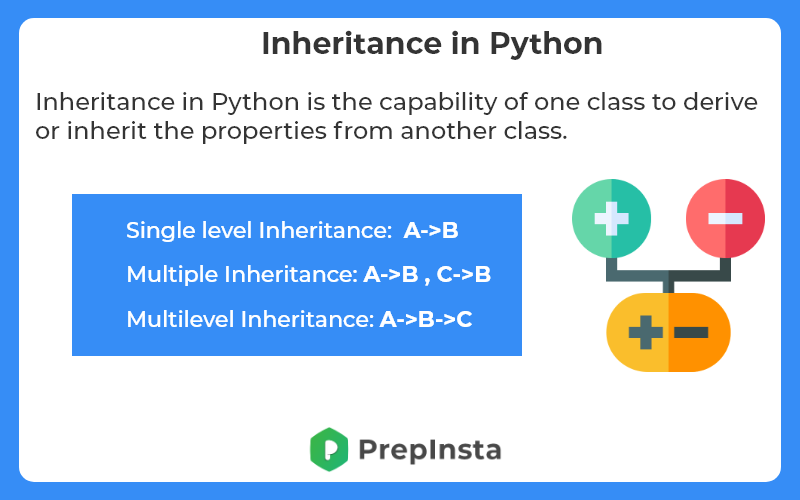
- Multilevel inheritance: When we have a child and grandchild type relationship.
Code #3
Output:
A
B
C
PrepInsta Prepster
- Hierarchical inheritance More than one derived classes are created from a single parent.
- Hybrid inheritance: This form combines more than one form of inheritance. Basically, it is a mixture of more than one type of inheritance.
Login/Signup to comment